Showing posts with label artifact. Show all posts

Saturday, July 30, 2011

All in a week's work...

Hi everyone,

To start off I suggest everyone take a look at this article in the Niles Daily Star. Thanks to Kate of the Star for coming out to the site last week to see what we are up to!

It certainly has been a busy week down at the site, but there are some excellent finds to show for it! This week was also the first week of Archaeology Campers, and we could not be more appreciative of the extra hands on site and hope the first group enjoyed the opportunity to work like a real archaeologist--digging, screening, paperwork, and all. Some of these campers decided to share their experience for the blog, so I will be posting one or two of these every so often so you all can hear about what is it like to join the staff and students in the pits. The following are the thoughts of one of these brave souls:

Some of our hard-working campers!
"We have learned much about the world of archaeology--from the lectures on the lives of those living in historic times to the eureka of discovery, granted it might be a bead, rock, or a not-so-old bottle...all are discoveries nonetheless.

We have also experienced the hard work of digging holes, sliding and sinking in mud, and washing artifacts in a dark basement. Still, what actually started out as a "bucket list" activity has turned into something I intend to do again."

I say the more future archaeologists the better! As for some of the great finds this week one of them may be the first feature of the year. A large stone, far too large to have been brought in by the river, has been uncovered in one of the units. At this time we are thinking that this may mark part of a foundation, and are eager to get back into the trenches to continue the investigation!

Other exciting finds include purple and white shell beads called wampum (please click the photo to the left for a close-up). Wampum were strung and woven together into belts by Native Americans to commemorate sacred and historic events like alliances and treaties. These belts were sometimes also used as currency, especially after the arrival of Europeans who began to produce the belts in greater quantities. This is such an exciting find because wampum is made from quahog or whelk shells that are only found along the northeast coast--these beads traveled quite a distance to get here, and likely mark some serious trade activities!

This is what it is "awl" about!
This week also marks the discovery of our first awl for this year. Awls made out of bone or antler were used by Native Americans to punch holes in hides in order to stitch them together. When Europeans entered the area they brought with them metal awls that could be used in trade negotiations. Awls are pointed tools that are much heavier than typical sewing needles, making them ideal for working with thick materials like leather. This type of tool has been around for thousands and thousands of years and has been made from many different materials including antler, bone, stone, and metal. Today many awl kits come with a wooden handle into which interchangable awl tips can be inserted.


Glass inset.
Two other eye-catching finds include a cufflink with green glass inset and a clear glass inset that also could have been part of a cufflink or some item of personal adornment. While these may be some of the most alluring finds, they are no more important than the bone and nails that we pull out of the dirt. For archaeologists every single type of artifact has the potential to tell a story. Nails can direct us towards the location of buildings, bones can tell us about what people were eating, and cufflinks can tell us about adornment styles. Each is a clue to understanding the past, and should not be overlooked.
Cufflink.


I will check back in tomorrow with an update on our lead bale seal, tales from campers, and more (I have to leave some surprises!). Thank you to everyone who came out to the Wednesday lecture and our Friday 2:00 tour. Also, a big thanks to those following along with our blog--we really appreciate your support!

Kelley


Photo credits Cathrine Davis

Thursday, July 28, 2011

Archaeology is a Battlefield

What’s happening, dedicated Fort St. Joseph followers,

Blogging tonight is your one and only FSJ resident funny man, The Lance Meister. Many of you may know me better as the hand holding projectile points and the beautifully preserved lead seal. This also could constitute me as the official hand model of the Fort, with a little luck that hand will keep popping up on the blog holding more of Nile’s great history.

Hanging by the lake at a volunteer's home.
Before getting into my finds and experiences working as a small cog in the FSJ machine, I would like to personally thank everyone involved in the project that goes unnoticed. A special thanks goes out to the sponsors for the amazing food and hospitality shown to our staff and students during our first weeks in Niles. We also appreciate the time and effort donated by our friends affiliated with Support the Fort, along with those hard working individuals there is you. Yes you…without you coming to our lectures, open house, site tours (Fridays at 2:00, if you’re not there you’re square) and following this blog, we wouldn’t have much of a reason to be here digging in the first place. The interest shown in the Fort St. Joseph Archaeological Field School and the open house that coincides with it is amazing and will only get better with your word of mouth. So while we are toiling in the mud and muck of the Fort site, we need you to spread the word, so get excited Niles and greater West Michigan, this is your history.


Explaining the unit.


Alright on to my side of this romance novel we are living out involving the dirty sweaty ladies and gents of the field school. Our love affair with the alluvium layers that represent the first 20-30 centimeters of shovel skimming and hand toweling, seemed to melt away like our Popsicle during last week’s heat wave. The heavy hand of last week’s heat was not an enemy left at the side of the river after site clean up, but a shadowy figure following us back to the hot box also known as Niles High School. It seems the only weapon we had to fend off this dastardly creature was the excitement of putting our dirty hands on incredible artifacts.


Ear bob!
Our weapon of choice was unearthed last Friday, an unbelievably well preserved lead bale seal that seemed to breathe new life into our collective lungs. After a short weekend the weather decided that intense heat would not bring us to our knees; Mother Nature opened up the clouds and brought rain upon us students. Ericka and I would need to reveal an artifact that could squelch the storms that were brewing; our comrades in digging would not be disappointed. An elegant and interestingly decorated ear bob, used for native adornment, would come to our defense and strike the sense of despair from our hearts. For this artifact would inspire and continue to drive us students to press on and laugh in the face of a few rain drops. So as a group we say not this time weather, with your wet and rainy clouds and sweat sapping heat, you will not slow down the progress of our group of archaeologists. We are simply too strong, too dedicated, and too darn good at what we do to allow Mother Nature to muck with our affection of uncovering New France’s secrets.

Stay Classy Niles
The Lance Meister

Photo credits Cathrine Davis

Wednesday, July 27, 2011

Summer Lecture Series and Tinkling Cones


Hi everyone,

Join us tonight at 7:30 in the community room of the Niles District Library for a lecture by Dr. Dean Anderson, the Michigan State Archaeologist. His talk is titled "Trade Between Cultures: The French Period in the Western Great Lakes Region," and will focus on the relationship between Native Americans and  the French in the Great Lakes region. This connection between cultures was based on trade that went beyond monetary exchange by playing a part in politics and alliance. Dr. Anderson will focus on the Native American side of the trade relationship.

Support the Fort members will again be providing snacks. Hope to see you there!

Another shot of the tinkling cone from Fort St. Joseph.
Photo credit Cathrine Davis
In a continuation of yesterday's post I wanted to elaborate on tinkling cones for our readers that may be less familiar with the term. Trade with the French increased Native American access to sheets of metal who, prior to the French arrival, were skilled in working copper. By the 17th century Native peoples were taking tiny scraps of metal, such as brass and copper, and cutting them into trapezoid shapes. These were then rolled to create a small metal cone. These could then be affixed to clothing, moccasins, bags, and other items. Some were incorporated into more elaborate designs using quillwork, etching, and animal fur. The name comes from the sound the cones make when they hit one another.


Example of a jingle dress.
Image courtesy of sewnative.com
The use of tinkling cones was widespread, and several examples have been found at Fort St. Joseph. These cones are still made and used today, often for jingle dresses for Powwow events.

See you tonight!

Kelley

Tuesday, July 26, 2011

Gettin Down and Dirty

“What on earth is that creature?!” “Was that bigfoot?” “Are they the muddied descendants of some lost tribe emerging from the forest?”

Visitors to the Fort St. Joseph archaeological site likely uttered similar musings amongst each other when they discovered mud covered students mucking out a trench Tuesday afternoon rather than pristine and professional looking excavators. Contrary to popular belief archaeology is not some romantic Indiana Jones movie complete with danger, drama, and romance. While there is the danger of stabbing yourself with sharp object in the wet screen, and the drama of uncovering a long hidden artifact is plenty to get your pulse pumping, archaeology is messy and hard work. In my personal opinion however, the sweat and the mud of real archaeology are BETTER than any silly Hollywood film (still many of us females wouldn’t say no to having Harrison Ford around at the site).

Just a little messy...
Some of you may be surprised to know that those of us who worked to muck out the trench belonging to the wet screens this past Tuesday afternoon jumped at the opportunity. What real archaeologist doesn’t love the feel of mud squishing between their toes and the opportunity to sling a wad or two at friends working nearby? Fun and games aside, the real reward in archaeology is emerging from the field, sweating, filthy, and knowing that you found something important that will help our generation better understand those generations past. In the unit I work in, N25W9, with my pit partner The Lance Meister, we have discovered numerous interesting artifacts that are helping us discover the lives of those who once resided at Fort St. Joseph.


Most notable are a lead seal, wonderfully preserved with French writing still legible on the surface, and the first tinkling cone of the season! The lead seal read “Graine de Lille”. Our resident seal expert happily informed us that this likely translates to seeds from Lille, Lille being a region in France. This was an important find because it says a lot about what kinds of supplies the fort residents were bringing in from France and clues us in to their ability to access materials from distant places. Remember guys these people did not have UPS!
First tinkling cone of the season!
Being the individual who holds a mud covered artifact for the first time in 100 years does not make you the sole winner in our game of hide and discover. Those who take care of all the jobs in between, like mucking out the trench, cooking dinner, supplying tarps for shade and saws for root cutting, share in the triumph of an archaeological discovery. That being said I’d like to give a special shout out to those community members who cook us dinner, kill poison ivy, help us dig, and most importantly give us the time of day when we are covered in filth and smelling not quite fresh. We would not be here without your support and so you should take the most pride in every muddy, rusted, or decaying artifact we pull from the ground.

YOU ROCK!
Erika :)

Photo credits Cathrine Davis

Monday, July 25, 2011

Party Pit

Hey Hey,

It's Joe. You know...Joe...from the chainsaw picture. Anyhow, tree killing aside, I've been working all last week with my Party Pit Partners (henceforth abbreviated PPP) Abby and Cathrine. We've done it! We have finally pressed beyond the dastardly roots and are treading forth into the unknown abyss that is the Archaeological Record! It's been a long time coming, but soil change has finally come to the northernmost excavation unit for this year's installment of the Fort St. Joseph Archaeological Project.

Gunspall
Yes, it's true. We may be rounding out the rear of the the group in terms of depth and recoveries. However, I will have you recall the tortoise, for lo!, our trowels strike true; we barely cross the 30 centimeter mark and we pull out a nail (kudos PPP Abby!), copious amounts of animal bone (huzzah PPP Cathrine!), and a beautiful flint gunspall of French origin (three cheers for Guest PPP Kelley!). As for this humble Party Pitter, I was able to uncover quite a few large rocks cluster in one area of the Pit that could be the beginning of a structural or hearth feature. Clearly, the party has just begun.

Student Theresa (right) with camper Heather!
Yet come lunchtime, mine eyes were greeted with the most jubilant site: our first crew of adult summer campers have arrived! They begin their tour of the site, they learn history behind the site, they begin excavation of the site - this (educational) party is swelling to epic proportions. We are excited for the help that ease our backs, for the help that will uncover the past, for getting people out there with us that want nothing more to be there at the wet screen, in the units, or even carting recycled kitty litter buckets of soil. Enthusiasm spreads quicker than the plague, and you don't even need rats!

Thus, I arrive to the most important part of my message to all you guys and gals out there in TV Land. We want to see you out here, whether it be as camper, as a Friday site tourer, or as an attendee of the Open House (August 13-14). Also, just take a look around town, ten to one you can pick us out. We've felt so welcome in your home, so please, come to our Archaeology Party down by the river. Do it as soon as possible, for this is a limited engagement...
The Party Pit Party Pic!

Until next time,
Joe Hearns

P.S. WHEN you come to the site, I'll be at N34 W16, most likely wearing a Baltimore Orioles hat; come hassle me!

Photo credits Cathrine Davis

Saturday, July 23, 2011

Lead seals and some history

Hi all,

I spy an artifact! Looks like part of a bone.
For this weekend update I wanted to keep everyone posted on our latest finds especially now that the students are getting down into layers dating to the occupation of the fort, but also spend some time summarizing the history of Fort St. Joseph for our readers that are less familiar with the site.

Yesterday our week ended early when a fast-moving storm swept into Niles, but the day was not without success. One of the most exciting finds came out of Lance and Erika's unit--a lead bale seal! These seals were used to identify and regulate the quality of merchandise, typically cloth. Seals found in this region typically date to the eighteenth century, matching with the time period of French presence at Fort St. Joseph! The impression on the seal would have been made when one disc was folded over to overlap with the other and then stamped closed. The impressions left would typically designate the place of the goods' origin as well as the quantity or quality.
"B GRAINE DE LILLE"

This particular seal is unlike any other found at Fort St. Joseph to date. The first line appears to be a "B" followed by a fleur de lis; the remainder looks as though it reads "GRAINE DE LILLE." Lille is a city in the north of France that specialized in textile production, which would lead us to think that this seal was used for cloth. Further evidence that this was connected to goods from Lille is the fleur de lis, the city's traditional coat of arms. What is puzzling is the actual translation of the writing, which is "seed/grain of Lille." Could this seal have been used for a shipment of B-grade wheat or other type of grain, or is it simply a way of saying that the seal marked a product from Lille? In some instances Jesuit priests attempted to have Native Americans adopt more intensive farming. Is it possible that seed from France was imported to Fort St. Joseph for this purpose? This may be a single artifact, but it certainly raises a lot of questions! If you have any ideas or thought please feel free to share them!

We have been finding a lot of beads that would have
been used for trade with Native Americans.
Jesuit priests were actually some of the earliest Europeans in the Fort St. Joseph area, arriving in the 1680s to establish a mission in hopes of converting the Native Americans that had been living in the area for thousands of years. In the 1700s the fort developed as a military and trading post for the French, supporting as many as fifteen households and potentially more depending on the season. The fort was particularly important in France's network of posts in the Great Lakes region, and saw a significant amount of trade between the French and the Miami and Potowatomi Native Americans.

Most artifacts are found when wet-screening.
The British gained control over the fort in 1761 during the French and Indian War; however, the British attitude of suppressing and dominating the Native Americans was very different from that of the French which consisted of intermarriage, gift-giving, and a mutual trade relationship. Thus in 1763 the Ottawa leader Pontiac lead a rebellion to drive the British from the region. The fort was briefly reoccupied by the British in 1779, but the presence in the region was not persistent unlike that of French traders that remained in the region until the 1780s, some possibly longer.

The reason the Spanish flag also flew over Fort St. Joseph is that a group of French and Native American men were sent to the fort by the Spanish governor of St. Louis in 1781, though the group remained at the site for less than a day. After that date the site of the fort was largely abandoned, though trade between Europeans and Native Americans likely continued in the area. This specific timeline makes the site excellent for archaeological excavations as there are no 19th and 20th-century occupations to obscure the dates of deposits.

If you have any questions about the fort's history or our ongoing excavations please do not hesitate to leave a question or comment! We will do our best to answer it or point you towards sources that may help.

Have a great weekend!
Kelley

Photo credits Cathrine Davis

Wednesday, July 13, 2011

Through the Labyrinth and on to the Maze

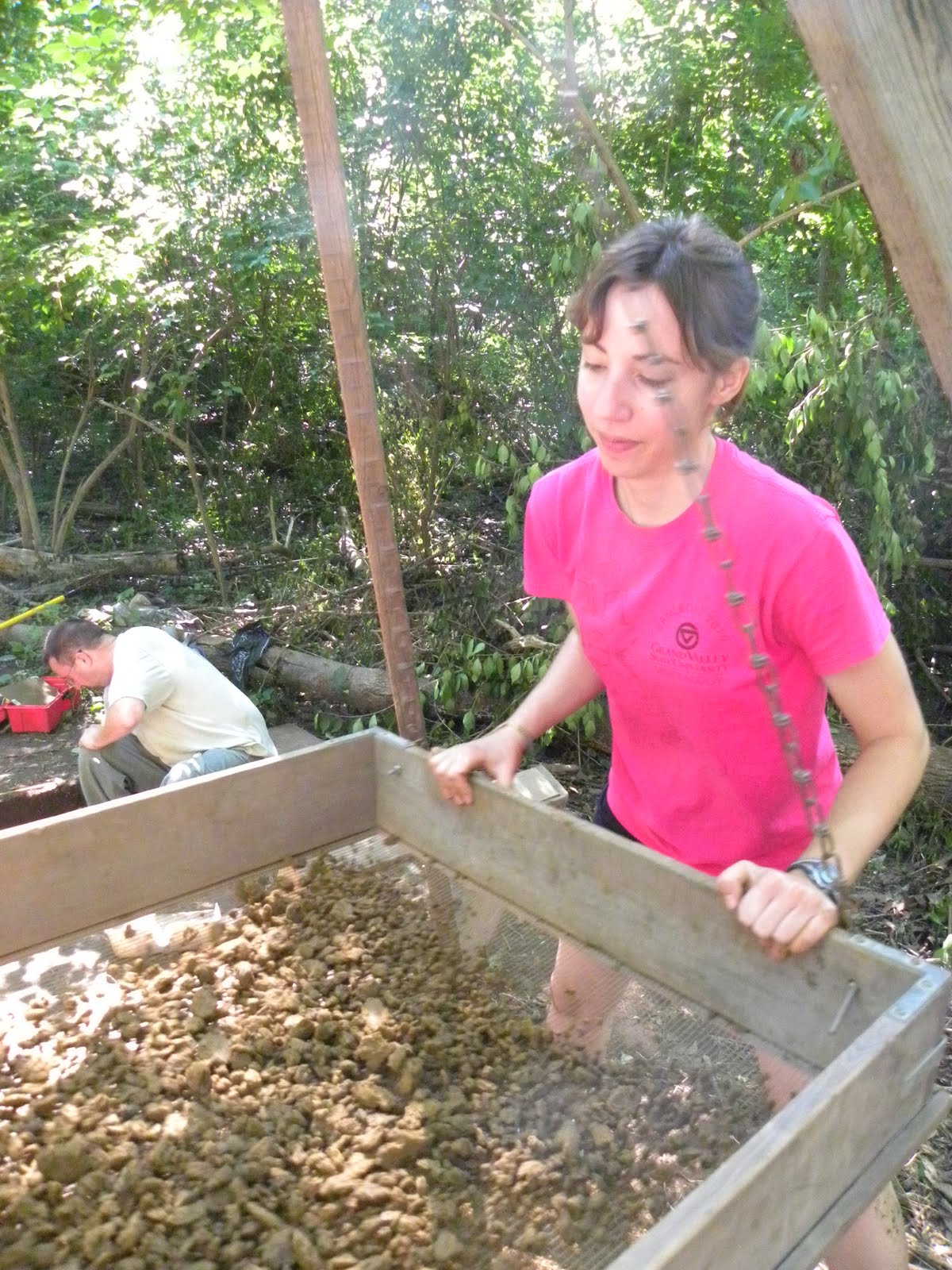
Enjoying some time at the screen!
Today my partner and I finished our unit at the Lyne site. We had a one by one meter unit on the Eastern edge of the site. Our unit gave us a lot of problems at the start of our excavation because we had roots coming out of our walls and popping up in every other spot they could. They varied in size, getting worse before they got better. On last count I think our largest root was six centimeters in diameter! We had a monopoly on the large tree trimmers for most, if not all, of the first couple of days of excavation. While working through our labyrinth of roots we had a constant hope that under the next root there would be a hidden treasure. We were not disappointed--our first find was clinker, which is what is left when coal is burned. As we broke through new ground, we began finding things between 20 to 30 cm. down from our starting point (what we archaeologists call the datum). We found a rusty nail and half of a rusty nail as well as a piece of brown glass.

Core left behind from flint-knapping.


One of the better finds that we had as we reached about 26 cm.below the datum was our unit's first evidence of native peoples in the area. I don't know how much everybody knows about flint knapping, but when stone points and tools were made the rocks used had distinct features left on them. There are three main forms of stones left behind in the archaeological record: a complete form, the core stone from which flakes were taken, and the flakes themselves that were broken off of the core or a stone while being formed. We found a large core, about the size of a small apple (click the photo for a close-up) and then a flake shortly afterward.


Now that we cleaned our walls and flattened our floor we await taking photographs tomorrow in order to close out our unit. By the end of tomorrow or Friday my partner Greg and I will be starting out in new terrain next to the river at the presently swampy Fort St. Joseph site.

Amber Strick

Photo credits Cathrine Davis

Tuesday, July 12, 2011

Back to the pits!

We're finally falling into our places here in Niles, some almost literally into their pits. We've been hanging out in town, and trying to get to know the local people who have been more than friendly to us. Out of the five days here, we have had two home cooked meals and have experienced more hospitality than what you’d get at your average hotel visit.

First stop in town: the memorial boulder for the site.
Last Friday was the first day we all had our very first pits and my pit partner, Lance, and I were feeling pretty hopeless around lunch time because the two girls, or archaeologists if you will, in the pit next to us were busy finding ceramics, a bone, and a flake. After lunch, another pit crew found a piece of a ceramic pipe, and after I handed it over to Lance to look at it, he rubbed it for good luck. Soon after our little laugh Lance found a projectile point in a bucket of dirt that I had shovel skimmed. Finally, we got the chance to brag about our spider-ridden pit!

We were excited to come back Monday and find a ton more artifacts, but it was pouring rain as we left Western Michigan University (WMU) to head to Niles so instead of attempting to trudge down the mud-laden hill we had the opportunity to head to the Northern Indiana Center for History. After looking around the museum for a little while, two WMU alumnae who work for the Center for History showed us some artifacts relevant to our work at Fort Saint Joseph and the Lyne Site. While my major doesn’t relate directly to the field school, it is always exciting to meet WMU alumni and I know a lot of my companions are considering the museum an excellent place to apply for an internship.

The second projectile point!
Today we were itching to get back in the field and uncover more artifacts and features. We got our supplies out of the trailer and set up the site quickly and repaired any damage left by the storm. Fortunately, my pit suffered no damage, just contained five cm. of run-off sediment. After we sorted through the especially muddy layer, we got back to where we had left off on Friday. While Lance dry-screened some dirt, I worked on the never-ending task of keeping our walls straight, I found another projectile point! Dr. Nassaney told me it was the first time anyone had found two projectile points in one pit at the Lyne site. This one had been repurposed, meaning that perhaps after a breakage the owner of this item etched the edge into a scraping implement. The rest of our day was spent finding pieces of charcoal and keeping up with the constant task of keeping our pit floor level.

Our work here certainly isn’t easy, but every day we go to the site with excitement for the day ahead. We all wait in anticipation for what we may find next!

Peace, Love & Dirt,
Abby Stoner

Photo credits Cathrine Davis

Saturday, July 9, 2011

Weekend update!

Lance holding the projectile point.


Hi everyone!

The students and staff are off for the weekend, but I wanted to take the opportunity to keep you all updated about the project. The group polished off the first week of the field session with a great find--a side-notched projectile point (click on the photo for a close-up)! Lance and Abby had a slow morning with few artifacts, and were pleased when this one surfaced. Hopefully we will have some more information about its origins after a bit of research. Other finds included some chert flakes, whiteware ceramics, glass, and an animal vertebrae. Not bad for two days in the field.

Xiaomeng screening for artifacts.


Students have been learning excavation and screening techniques at the Lyne Site and, based on my time at the site, are fast learners! Everyone should be well-prepared for excavations at the fort site in the next week or so.


I also wanted to take this opportunity to tell you a little bit about my involvement with the project. I first began pursuing archaeology as an undergrad at the University of Toronto and had the good fortune of finding a job in Cultural Resource Management (CRM) close to home in Maryland shortly thereafter. CRM archaeology is conducted in compliance with state and federal laws, and I had great opportunities to work on different types of sites conducting excavations, mapping, writing reports, cataloging artifacts, and much more. I also became a part of the Port Tobacco Archaeological Project which catered to my interest in Public Archaeology. Before long I was enrolled as a Master's student at The College of William and Mary, and am happy to report that I have successfully defended my thesis which deals with public and collaborative archaeologies.

Me enjoying the South Bend 4-H fair!
I am grateful to be a part of the Fort St. Joesph Archaeological Project where as the Public Outreach Coordinator I can really explore my interest in and dedication to archaeology that involves various communities. My time in Niles this far has been excellent: I encounter many great people on a daily basis that are very interested in what the project is doing. Even in my off-time I have found plenty of things to keep me busy, whether it be exploring downtown Niles or heading to South Bend for a baseball game.

See you all around town!
Kelley

Photo credits Cathrine Davis and Kelley Walter

Thursday, July 7, 2011

It's all Greek to me!!!

I get to be the second blogger here at the FSJ Field School. This is my first year participating in the field school. I was really excited when I was chosen to participate this year. I have been learning about Fort St. Joseph and the field school for two years now and I am ready to get my hands dirty. (Get it… we dig in the dirt).
Clearing the site.
I would have to say that not only was today an interesting day but also a very productive day. We started out by heading to the Lyne site which is near the Fort St. Joseph rock. At the Lyne sited we had to clear a bunch of over growth and fallen trees so that we could set up to start digging. It was a lot of work and especially team work, some of the trees we moved took most of us to move. We took a lunch break and cleared for about another hour. At this point we were about ready to set up our units we planned to excavate.


Then the fun stuff began. We received our pit partner assignments and started to dig. It’s a slow process and normally you don’t find too much stuff in the top 5 cm or so that is really interesting, but today was another story. My pit partner Erica and I actually found the first artifact of the season- a stone flake. Something so small that many people would most likely think it was another stone, but to us it meant a lot more.

For those of you who do not know, when I talk about this stone flake it is basically a piece of rock that is broken from another rock while trying to produce a stone tool. Stone tools first show up in the early Paleolithic (about 2.5 million years ago) and were still used by many of the natives that lived around Fort St. Joseph. This gives us more proof that there was interaction with natives or at least they were around the area at some point in time.
Erica and Amanda with the first artifact of the season!

Though this flake is about the size of a dime, I am thoroughly excited. I mean, how many people get to say that they get to play in the dirt for a job (as we joke)! Who gets to work with things that people haven’t seen in hundreds of years? I mean this small flake we found was a part of something much larger at one point.
My final thought of the night. While today, being the day for breaking ground and getting started was a long and tiring day, what items we’re finding here today could change history.
To all I must now say goodnight as we have another busy day in the field
Sincerely,
Amanda

Photo credits Cathrine Davis