Tuesday, July 19, 2011

Diggin' Your Roots


The site.
Hi everyone, I'm the intern of this year's field school! I like to think of myself as the site's ghost excavator, since I kind of float around to different units as needed, helping out when someone's pit partner is gone for the day or out sick, and just generally doing whatever odd jobs need to be done. I have so far worked with a lot of different people and in all different types of units (ones with lots of roots, rocks, loose soil, hard packed soil, muddy, etc.). 


Joe taking on the roots!
Today, as well as yesterday, I was working with Amanda and Max on their fort site unit. It had a lot of roots in it, which required quite a bit of time to work through, but we finally got all of the big ones out, especially "Big Bertha" (yes we named our roots), and it really paid off! It seems that once we just got through that top layer of roots they now have quite a nice unit, with fairly loose soil, and shade. It has given hope to the adjacent L-shaped units who are still struggling through even bigger tree roots to get to the good stuff beneath; they had to take a chainsaw to some of the roots they were so big!


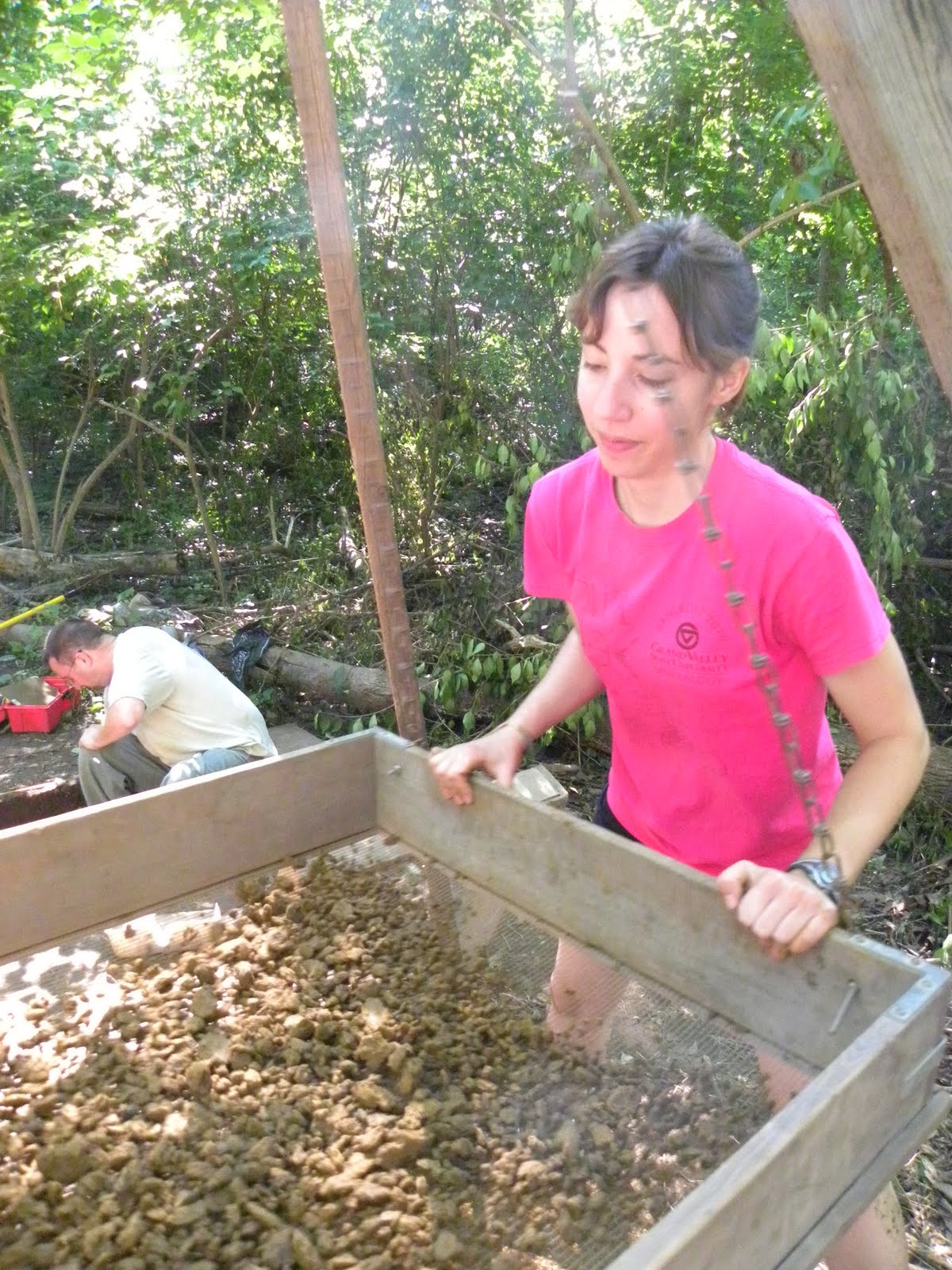
Of course some of the units without all of those natural obstacles to get through have already dug out the majority of their alluvium layer and are beginning to see signs of the plow zone, and more importantly, artifacts! We began our wet screening operation today,
Water-screening.
setting up the necessary pump and hoses and having our subsequent "teaching moment" on how to and why we wet screen. In summary: the soil at the Fort is mostly wet clay, so the only way to be able to effectively screen the soil is with water. We spray pressurized water at the dirt and through the screen and expose the really small artifacts that we might otherwise miss. As you can imagine, combining muddy soil and water is a somewhat messy task, yet very important and even fun, especially on such a hot day like today. The wet screening yielded some nice finds today, including lots of bone, some lead shot, and even a part of a gunflint we able to be identified as French from its honey coloration.

All in all it was a very productive day and I hope you are just as excited as we are to discover what else is hiding in the soil, and beneath the roots! And if you'd like to learn more about Fort St. Joseph and especially about the fur trade (or would just like to meet this year's wonderful archaeolo
gists) please join us tomorrow, Wednesday, at the Niles public library at 7:30pm for the first of this summer's public lecture series. Hope to see you all there!!
Just being a ghost excavator!

~Devora Gleiber


Photo credits Cathrine Davis.

Monday, July 18, 2011

Tales from the Excavation

Fighting the roots.
We arrived at the Fort St. Joseph site this morning. We gazed upon the site, eager to dig the units meticulously prepared the past weekend. Our trowels grasped firmly in hand, we received our assignments and set forth into the wetlands, prepared to do battle with the quagmire of Mother Nature. I glanced at my partners in excavation, our battle plan already made for the removal of twenty centimeters of alluvium. Alluvium, what a cursed word! The river has deposited silt over the years, with vegetation stacking high above the precious ground hiding the keys to the past. Oh alluvium, how we hate thee!

The pumps hummed in the background, splashing the water from the depths below. The ground dried slowly as we were assaulted once again by Mother Nature. The rain cooled us as we continued to dig slowly through the mud, centimeter by centimeter. We found no artifacts, for the fort is buried deep beyond the sight of human kind. We continued to shovel, removing the alluvium and making steady progress. Baby steps to the fort, baby steps.
Centimeter by centimeter...

The sun came from beyond the clouds, joining the humidity in the assault against progress. I could feel my body losing energy, forcing me to pause and hydrate. Heat stroke and dehydration are both enemies, constantly forcing archaeologists to pause  in their quest. I regained my energy, pushing onward despite the conditions.

As the sweat ran down my brow I continued my journey into the depth of the past. But, what's this?! Roots, the bane of archaeology! Thick, strong root from the towering trees of the forest blocked our path to clues to history. I grabbed the root clippers, vanquishing the beast from our path. With the roots and alluvium removed, we were free to move farther down towards the depths of the fort. While only twenty centimeters in, we have faced challenges at which some humans would balk, but we have prevailed and shall continue as we move that much closer to the past.

Tellin' it like it is.
Until next time,
Alex


Photo credit Cathrine Davis

Sunday, July 17, 2011

Speaker Series starts this Wednesday!

Hi everyone,

Please take the time to consider attending one of our upcoming Lecture Series events. These begin Wednesday, July 20th at 7:30, and continue for the three following Wednesdays at the Niles District Library. This week's speaker is Dr. José António Brandão, the Chair and Professor of History at Western Michigan University. His talk will focus on the relation between the French and the fur trade in Michigan. Please click the image below to be able to zoom-in on the details. Support the Fort will be providing snacks!

Also please check out this press release from the Michigan Humanities Council (MHC). This year the MHC awarded the Fort St. Joseph Archaeology Project a grant of $10,175 in support of our Open House event on August 13th and 14th that will showcase excavations, historical interpreters, and more! This grant certainly has been an excellent boon to the project.

Tomorrow we are back at the Fort Site. It is going to be a hot week, but hopefully one full of great finds. I hope to see you all at the talk on Wednesday; please be in touch if you have any questions about the speaker events.

Kelley

Saturday, July 16, 2011

Well-deserved rest

Hi everyone,

Total Station.
Prism.
This week the crew wrapped up work at the Lyne Site. It has been a long week and while everyone is eager to begin excavation at the Fort Site I know most of us are ready for a little R&R. The students have been cleaning up the floors of their units, drawing profiles, and doing final photographs. The groups that finished up first headed down to the Fort Site to put in a trench and help Zach and I lay in some units with the Total Station, a piece of survey equipment used to calculate exact coordinates and elevations. You have probably seen these used by construction crews or land surveyors, but they are increasingly become the measurement tool of choice for archaeologists  as well. The device works when a laser is shot from the main station (see left) to a prism (at right) attached to the top of a rod that is held at the point to be measured.


Greg leveling the floor.
Photo credit Cathrine Davis.
It was great to have the opportunity to be on site more often this week than the last even if I still was dividing my time between meetings and paperwork. Another activity that I, along with a student, do every week is set-up a table at the French Market. This provides the community an opportunity to interact with members of the project, learn about archaeology, and generally be more involved in our work.  Even on days when the market is a little slower we have plenty of folks stopping by to hear about the latest finds and just how muddy the Fort Site really is! We always have a good mix of folks that remember us from previous years and those that are just getting acquainted with the project. I really appreciate the opportunity to get to know the people of Niles better and besides, spending the day surrounded by all of those stands with delicious fresh produce cannot be beat! Please stop by to visit us on Thursdays from 9 a.m. to 2 p.m.


Erika M. and I at the French Market.
On Monday everyone should be setting up shop at the Fort Site. We will be sure to keep you posted about our discoveries!

Have a great weekend,
Kelley

Thursday, July 14, 2011

Another Awesome Day at the Site!

Down to the B-Horizon/subsoil.
Theresa and I with our unit!
Hello there boys and girls. Another successful day at the site. My partner, Theresa, and I are almost finished with our first excavation unit. We have been diligently excavating for about a week. We've found a handful of artifacts but nothing quite as cool as some of the other archaeologists on our team. They have found some really neat arrowheads, cores, flakes and bones. We will continue on with hopes of the awesome finds to come. I am learning a lot about excavation techniques and what it takes to be an archaeologist.


I would like to point out how awesome the community is here in Niles, MI. Special thanks go out to Mary Ellen (the Cookie Lady) and Margaret, who invited the whole crowd of us to their houses for dinner and a pool party. Once again, thanks.
The well-fed crew with our gracious hosts.

Thanks,
Bryan Bommersbach

Photo credits Cathrine Davis

Wednesday, July 13, 2011

Through the Labyrinth and on to the Maze

Enjoying some time at the screen!
Today my partner and I finished our unit at the Lyne site. We had a one by one meter unit on the Eastern edge of the site. Our unit gave us a lot of problems at the start of our excavation because we had roots coming out of our walls and popping up in every other spot they could. They varied in size, getting worse before they got better. On last count I think our largest root was six centimeters in diameter! We had a monopoly on the large tree trimmers for most, if not all, of the first couple of days of excavation. While working through our labyrinth of roots we had a constant hope that under the next root there would be a hidden treasure. We were not disappointed--our first find was clinker, which is what is left when coal is burned. As we broke through new ground, we began finding things between 20 to 30 cm. down from our starting point (what we archaeologists call the datum). We found a rusty nail and half of a rusty nail as well as a piece of brown glass.

Core left behind from flint-knapping.


One of the better finds that we had as we reached about 26 cm.below the datum was our unit's first evidence of native peoples in the area. I don't know how much everybody knows about flint knapping, but when stone points and tools were made the rocks used had distinct features left on them. There are three main forms of stones left behind in the archaeological record: a complete form, the core stone from which flakes were taken, and the flakes themselves that were broken off of the core or a stone while being formed. We found a large core, about the size of a small apple (click the photo for a close-up) and then a flake shortly afterward.


Now that we cleaned our walls and flattened our floor we await taking photographs tomorrow in order to close out our unit. By the end of tomorrow or Friday my partner Greg and I will be starting out in new terrain next to the river at the presently swampy Fort St. Joseph site.

Amber Strick

Photo credits Cathrine Davis

Tuesday, July 12, 2011

Back to the pits!

We're finally falling into our places here in Niles, some almost literally into their pits. We've been hanging out in town, and trying to get to know the local people who have been more than friendly to us. Out of the five days here, we have had two home cooked meals and have experienced more hospitality than what you’d get at your average hotel visit.

First stop in town: the memorial boulder for the site.
Last Friday was the first day we all had our very first pits and my pit partner, Lance, and I were feeling pretty hopeless around lunch time because the two girls, or archaeologists if you will, in the pit next to us were busy finding ceramics, a bone, and a flake. After lunch, another pit crew found a piece of a ceramic pipe, and after I handed it over to Lance to look at it, he rubbed it for good luck. Soon after our little laugh Lance found a projectile point in a bucket of dirt that I had shovel skimmed. Finally, we got the chance to brag about our spider-ridden pit!

We were excited to come back Monday and find a ton more artifacts, but it was pouring rain as we left Western Michigan University (WMU) to head to Niles so instead of attempting to trudge down the mud-laden hill we had the opportunity to head to the Northern Indiana Center for History. After looking around the museum for a little while, two WMU alumnae who work for the Center for History showed us some artifacts relevant to our work at Fort Saint Joseph and the Lyne Site. While my major doesn’t relate directly to the field school, it is always exciting to meet WMU alumni and I know a lot of my companions are considering the museum an excellent place to apply for an internship.

The second projectile point!
Today we were itching to get back in the field and uncover more artifacts and features. We got our supplies out of the trailer and set up the site quickly and repaired any damage left by the storm. Fortunately, my pit suffered no damage, just contained five cm. of run-off sediment. After we sorted through the especially muddy layer, we got back to where we had left off on Friday. While Lance dry-screened some dirt, I worked on the never-ending task of keeping our walls straight, I found another projectile point! Dr. Nassaney told me it was the first time anyone had found two projectile points in one pit at the Lyne site. This one had been repurposed, meaning that perhaps after a breakage the owner of this item etched the edge into a scraping implement. The rest of our day was spent finding pieces of charcoal and keeping up with the constant task of keeping our pit floor level.

Our work here certainly isn’t easy, but every day we go to the site with excitement for the day ahead. We all wait in anticipation for what we may find next!

Peace, Love & Dirt,
Abby Stoner

Photo credits Cathrine Davis