Thursday, August 2, 2012

Food for the Masses


Hello, friends! We’ve enjoyed another gloriously busy day in the field. Though the artifacts weren’t pouring out of the Pit of Opportunity today, we learned a lot and once again experienced the undying hospitality of the people of Niles.
Thank you, Kiwanis Club!


We were lucky enough to have the Kiwanis Club provide a bountiful lunch for us in the field. Thank you, Kiwanis Club, for the generous gift and affection you showed us today!


Hard at work in the field


Our cultural finds of the day included a window hinge, a blue cut glass stone (hopefully from a ring that we will discover in its entirety in a few centimeters…), portions of a blade, wampum, and a piece of wire described by the Good Doctor as the ‘duct tape of the 18th century.” So what do we think they used in place of WD-40?


After the eventful day in the field, we students were finally given the chance to give a little bit of affection back to the community. With the usual helpful kindness of the Layman family, we hosted a barbecue at the farmhouse. Has there ever been an archaeological field school that ate this well?! A special thanks to all of our friends for coming out to see us this evening.


Joe vs. Cobbler


Our goal in the field this year is to continue uncovering a few of the features discovered in past field schools. A hearth and a fireplace, discovered deep beneath the alluvium in years previous, were re-excavated this season, in order for us to have a better visual of how the buildings in the fort were laid out. None of the units have uncovered the walls we are searching for, YET. Keep it tuned, folks, we have a good feeling about those walls.


Wednesday, August 1, 2012

Unlocking the 18th century


What can we unlock?
Trigger guard got the site buzzing


Today was an exciting day at the fort site. We are in full swing now with wet screening going on continuously and people already through the alluvial and plow zones. With the first few units hitting the levels of occupation some very interesting artifacts have come out. Some of today's are sure to be highlights of this field season. Tonight was also part 3 of the lecture series at the Niles senior center with Bob Meyers and his presentation of “Marines and Militia of Fort St. Joseph”.
4 of the wet screening stations
                We have five wet screens going nonstop, and our pump was only shut down twice, once for lunch and another to be refueled. Buckets were being filled faster than they could be screened and all the expected artifacts were coming out. We have found large amounts of bone, beads, and various metal scraps. What got people really pumped though were a couple of keys and a trigger guard, all coming from the same 2x1 meter unit! Hopefully the trio working in the area will find plenty more and give us a little more information, adding to our understanding of the fort and New France.
today's lucky trio
                Even though we have been doing this for over a month it still is an amazing feeling to be the first person in centuries to touch whatever it is that you’re pulling out of the ground. These artifacts represent little bits in the puzzle of who these people were and how they spent their time, the everyday things that weren’t written down. That’s what we are searching for as archaeologists. The unwritten pages in history are vast and we have accepted the challenge of filling them.
                Part 3 of 4 of our lecture series was tonight at the Niles senior center. Bob Meyers gave an informative presentation on the military history of Fort St. Joseph. The lectures are always a welcomed opportunity to spray the mud off ourselves and get into a more classroom like setting. They are always filled with good people and great presenters, and tonight’s was no different. We could not ask for more gracious hosts, the people of Niles have greeted us with open arms everywhere we go.


As usual, Joe being sassy.

Tuesday, July 31, 2012

Artifacts and Facts of Art


Jon surveying the damage.
  Today was our second full day at Fort site.  The morning began with reminders of the unexpected nature of archaeology: a tree fallen across one tetrapod, excavations turned into swimming pools, even a friendly bullfrog trying to take up residence in our unit!  No worries, though – we archaeologists made short work of the cleanup and soon launched into the day’s digging.  Everyone is aware of the time crunch; with only a week and a half left before Open House, we will need to muster all our energy and expertise to finish our excavations.


The wet-screening station.
    It really wouldn’t be so bad if our site wasn't so plentiful and giving.  Now that we are beyond the layer of alluvium, the soil deposited by the river, artifacts are turning up nearly as fast as we can trowel.  My partner Michelle and I found quite a few shards of discarded animal bones in Pit Gelller, as well as what might have been a European flint firestarter –finds that make a lot of sense in their context near a previously discovered hearth.  Broken bits of faience, or glazed French earthenware, have been found across the site as well as additional glass seed beads.  Pit Tassie (home to Tabitha and Cassie) found a beautifully decorated bead from what have been a bracelet, and Annie, Jordan, and Scott’s pit yielded both wampum and a mouth harp that looks nearly new.


Annie playing the mouth harp.
            After lunch, we had the pleasure of hosting some of the summer campers who were both attentive and helpful. Michelle and I were at the stage of level mapping, and sadly weren't interesting enough for demonstration, but other groups had visitors. In particular, Tabitha and Cassie had the assistance of Alec, a young man who became very good at identifying bone.  We are very glad to have the campers with us!
Calvin, Mary Ellen, Charlie, and Ashley.

Joe, wanting you to envy us.
            Other exciting things were found in the afternoon, such as clay pipestems, but Michelle and I had to leave early to facilitate another key part of field school: dinner.  Aside from showering, food time is the most important part of an archaeologist’s day, and us students take turns providing sustenance to our fellow hungerers in the evening. Tonight’s menu included: homemade tomato soup, grilled cheese with ham, summer carrot salad, and chocolate-upon-chocolate cake.  Feel free to envy us all! 


- Sarah Oren

Public Lecture Tomorrow Night

Join us for the next talk in our public lecture series tomorrow night. Robert Myers will give a presentation titled "Marines and Militia: The Military History of Fort St. Joseph" beginning at 7pm. It will be held at the Niles Senior Center. We hope you can make it!

Monday, July 30, 2012

Finally Digging at the Fort Site!


Today was the day that we have all been waiting for; we finally broke ground at the fort site!  In the morning we were working on opening up past units until we got down to tarps that covered them from previous excavations. 
Uncovering previous units
Were reopening features ten and fourteen which contained fireplace features from previous years so we can attempt to locate walls of an eighteenth century building. After this tedious process we were allowed to open up our brand new 2 by 1 meter unit. Mostly everyone seemed to get a pretty good unit, well everyone except for mine and Calvin’s unit. Calvin and I got blessed with the privilege of having a nice tree directly on the south wall of our unit that is producing some awesome roots that we just love digging around and through. As one can imagine these roots are severely holding up the excavation process for my pit partner and I. In my unit specifically we are probably around six or seven centimeters at the most, in the rest of the units most people are at 25 centimeters down or more. Already some artifacts are being found in some units which is pretty exciting for everyone on the site. We found the most artifacts at the end of the day when we had our first lesson on wet screening. Found in the wet screen was one musket ball, multiple seed beads and lead shot, and countless animal bones.  
Wet screening demo


Our amazing dinner!
Now I understand why they recommend wearing flip flops while wet screening, after I was finished my shoes and legs were soaked. But it was very refreshing after being in the hot sun all day. Even though it was a great feeling starting at the fort site today, for me the highlight of the day was the food that the Layman family had made for us. If I could cook as well as Stephanie Layman does I would be about ten thousand pounds by now. I would like to formally thank Stephanie and anyone who helped with dinner tonight, it was fabulous as always.  Tonight I will go to bed dreaming of the meatballs from dinner and then musket balls from the site.


Force feeding michelle
-Ashley

Thursday, July 26, 2012

These Hands


           Ground was broken today, for the first time this season, at the Fort site. We will be moving our work there from the Lyne site on Monday and we will all finally begin the archaeology that we have so longed for. However, before we can move our work to the Fort site we have to finish our work at the Lyne site. This meant that every pair of hands was working feverishly with a new fire of aspiration lit under the archaeologist attached to them. Today, these hands, the hands of every person working in the Fort Saint Joseph Archaeological project excavated with an accurate intensity and the goal of digging the fastest and hardest they have yet. We’re going to finish these units and we’re going to dig the Fort.
            Where did we leave off from yesterday when we started these units? Less than twenty centimeters down!? It’s go time. These hands are ready to move. With a newly developing muscle memory this work is becoming second nature and we’re prepared to make it the last twenty centimeters by the end of the day. A challenge that we’re all up to; digging hard and digging well.
            Shovels and trowels working in a flurry, removing a centimeter of earth with every shovel-full. Buckets filled with soil faster than we were able to screen it. One person digs and the other screens. A non-stop flow of Archaeology ensued. Like the workers on the Henry Ford assembly line, our hands moved with skill in a new effective system of constant activity. Before you know it, you’ve finished your level and are ready to begin mapping.
            Measuring tape and levels. Make sure the floor is even. Put those fingers to work at clipping away those last few roots and mapping in the ones too large to take out. What’s the soil matrix? Note the change in the color and texture. Are we already that deep? Make your measurements precise and don’t miss a thing. Just because we’re working fast doesn’t mean we can be sloppy. Note the artifacts we’re finding; a handful of flakes, a few nails, bits of charcoal, some fire-cracked rock. Jon and Sue found some iron and lead shot! That’s good, but don’t get distracted. The paperwork is approved! Get more paperwork and get ready to go down another level. Back to digging.
            After an hour of repetitive motion, your hands seem to form to the handle of the shovel, of the trowel, of the handle on the 1/8 inch dry screen. Eyes are constantly scanning while hands are constantly moving. Is that a culturally significant piece of altered stone, or just a beautiful example of a Michigan pebble? Bag the flakes and don’t miss a thing. The buckets are filled with soil again and need to be screened! You can’t dig if you have nowhere to put the dirt. Bucket after bucket, your hands and eyes work independently of one another in a Zen-like state of artifact searching and identification. Did I miss anything? Re-check and then re-re-check. After all of this it is easy to lose sight of the big picture, of the significance of what exactly it is you are pulling out of the earth after hundreds of years of laying motionless and unseen.
            And then you find it; an artifact that takes your breath away and causes your heart to skip a beat. For me, it was the tip of what is possibly a bi-facially chipped projectile point or stone drill. For Sue and Jon it may have been the projectile point that was discarded mid-production. For Adam and Annie it may be the bullet casing that had visible English printing on it. You see the excitement of other peoples’ faces when they get to see and touch what you just pulled out of the ground. These were made and altered by human hands hundreds of years ago just like our hands working so eagerly to recover what may have just been cast aside.
            At these moments, you take a step back, you give your hands a rest, you take it all in and remember the significance of what it is your hands are doing and touching. We are finding objects that time had forgotten and bringing them back to life and relevance with our own amazement, interpretations, and wonder. The excitement takes you once again and you return to your work with a new zeal and respect. You now have in mind the feeling of what a single artifact can give you and your mind begins to race with the thoughts of the amazing things we have yet to uncover within the Fort site. Monday couldn’t come fast enough. 

Wednesday, July 25, 2012

How Many Archaeologists can you fit into a 1x1 meter unit?


Who would have ever thought of this question?  Well, in case you ever wondered, we have proof that it is 5!  However, there is talk of a possibility of 6, so stay tuned!  It’s Wednesday of week 3 and many of us have closed out our first unit and just opened up our second.  It’s also noticeable that everyone is getting on the goofy side, which makes this even more fun, but we remain focused. 
5 Archaeologists fit into a 1x1 meter unit
Cassie, Tabitha, Erica, Michelle and Leah


Many of us found quite a few items in our first units at the Lyne site, but the last 20 cm were quite lacking in artifacts.  I hadn’t been at the site for two days and it was strange to see my unit that I had worked on with my pit partner, Jon, all filled in.  Actually, it was kind of sad; it’s like moving from your first home to another home, the first one is always special.  After the units are all documented, photos are taken and when all the paperwork is done, each unit is filled in.  It was exciting that we were assigned a new unit to begin just about 15 meters off the river.  Wow, riverfront property, the high rent district.  All the excitement of opening up our first unit started all over again as we laid out our second unit.  It went much quicker this time and within 30 minutes we had our unit all measured, string line completed, datum line tied on, all beginning measurements taken and we started in with shovel skimming.  This didn’t last long as the amount of roots in our unit increased and using a trowel was the best way to go. 

Within our unit we found 27 stone flakes, and we’ve only gone down 10 cm. Jordan and Scott found the first musket ball of the season.  The life-long campers came in after lunch to start their units and many of them joined us at our units and gave us a hand.  Our camper, Jill, learned quickly how to start identifying stone flakes, way to go Jill! 
Jordan holding their musket ball, the first one found this year!
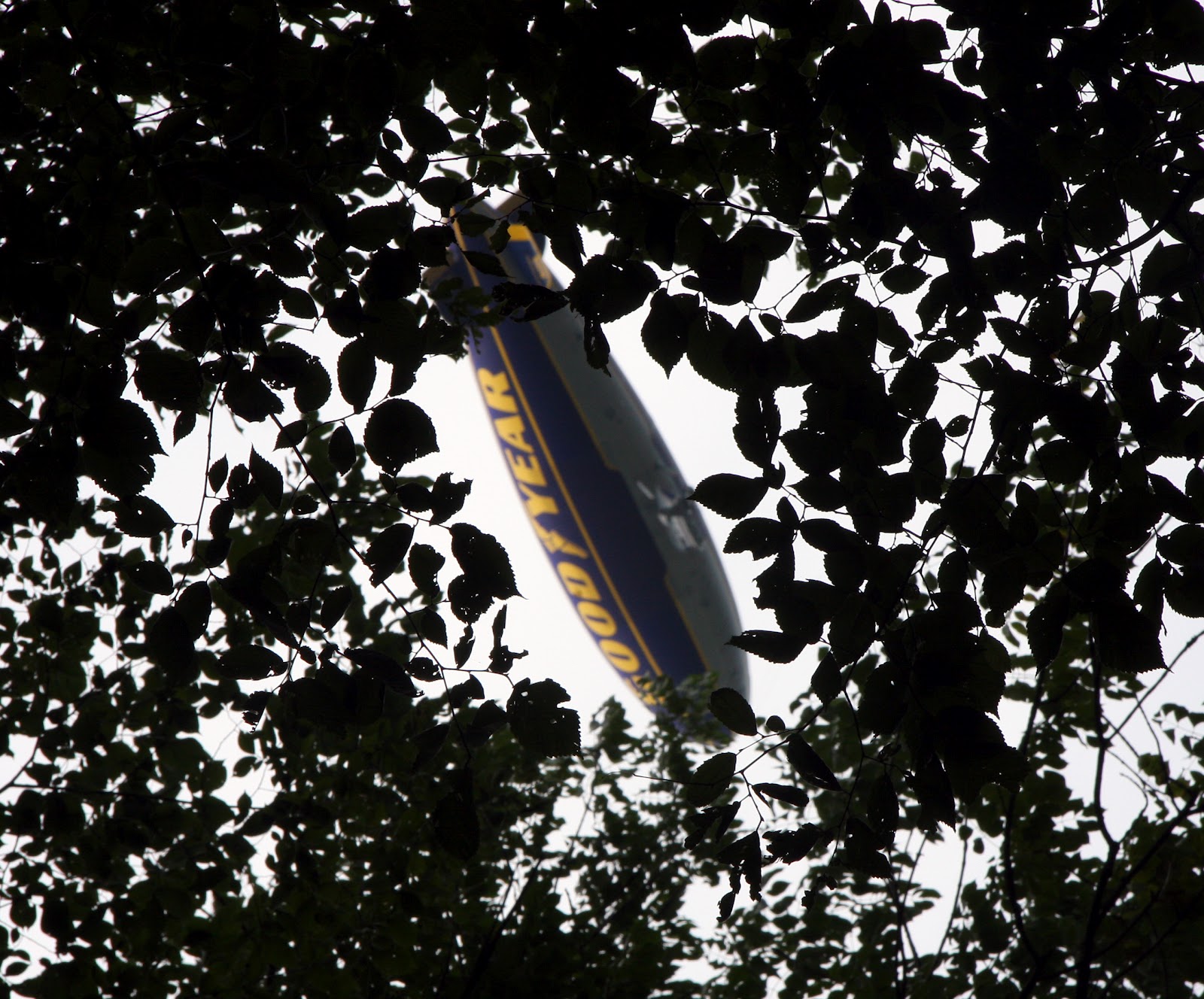
We had about a 30 minute rain delay as a rain storm came through and we got to the cars just in time, great timing!  Right after lunch we heard some strange noise and looked up and we had the Goodyear Blimp overhead, what a contrast to us digging up 17th century artifacts.   


The Goodyear Blimp visits Fort St. Joseph

Coming through town we noticed the new sign that is up over downtown advertising our Open House that is being held August 11-12, Niles does a great job of supporting us which is evident every day from the great people here.  

The Fort St. Joseph Open House Sign in downtown Niles.  Great Advertising!


Also today was our second Speaker Lecture Series, Mr. Larry Horrigan titled “Firearms of New France” dressed in 17th century Voyageur clothes, Mr. Horrigan spoke to a large crowd at the Niles Library and shared his extensive knowledge of the history and how the flintlocks were used. 


Mr. Larry Horrigan speaking on the “Firearms of New France”


Tomorrow should be another exciting day as we head back into the field, let’s hope the rain cooperates and comes when we’re not in the field.
Sue