Monday, November 12, 2012

A Trip to Niles


Leah, Tabitha, and I were sitting in the lab, doing our usual work, when Alex informed us that he needed a couple of us to do a presentation.
 I look at Leah and Tabitha, then back to Alex and ask “what is it for?”
“Support the Fort would like to know what happened this season. It’s next Tuesday.”
Thinking it over, I agree to do this presentation with Leah.  Now just have to figure out the most amazing PowerPoint I could create.
The waves were giant!
Tuesday fast approached and Hurricane Sandy has been pounding the east coast. Due to the size of Sandy, Lake Michigan was having massive waves! A must see! Leah and I left a couple hours early to stop by the beach at Lake Michigan in St. Joseph.
Lines of cars backed up the beach’s shore, everyone trying to get a glance at the large waves crashing against the beach. Leah is trying to maneuver the car into a prime spot to get pictures on my camera. The high winds were screaming past my window, while I’m hoping to God that I don’t drop my phone out the window! After capturing a couple pictures, Leah follows the long line to make our way to the Niles Senior Center.
At the Niles Senior Center, my PowerPoint was set up, except we had a missing cord! The cord that would attach the projector to my computer was nowhere to be found. Fifteen minutes and multiple cookies [thanks Mary Ellen!] later, Support the Fort members gathered around my computer screen and the presentation commences. Leah and I discussed:
  • The field season: our focus on finding the size of the houses, the special artifacts we found, more about the Lyne site, uncovering past excavated fireplaces
  • The open house: the re-enactors, having 1800 visitors, having exposed the pits to show the public
  • What we personally learned: being an archaeologist, working with different people, importance of public outreach
  • Lab: Pastperfect, inventory, labeling artifacts, fine sort, our visit to Michigan Archaeology Day
  • Our personal experience

Heading home, bags of cookies in hand, Leah and I discuss how great of an experience it was presenting to a great group of people; people who do so much for us. Public outreach is a great thing and full of a variety of rewards (including cookies sometimes).
    -Cassie Mohney

Friday, October 12, 2012

A Weekend With New France

The food was excellent!

Each year, the Center for French Colonial Studies holds an annual meeting to encourage scholarship, foster learning, and hear presentations on topic related to the French in the New World.  Dr. Nassaney and I attended this year's conference on September 28 and 29 in beautiful Bloomington, Indiana, sponsored by the Mathers Museum of World Culture & the Glenn A. Black Laboratory and Indiana University.
            The weekend began on Friday with a workshop in the Great Lakes Ethnohistory Archives in the Glenn A. Black Laboratory. Participants had the opportunity to examine the incredible collection of primary and secondary resources assembled on behalf of the U.S. Department of Justice for the Indian Claims Commission. Intended to provide evidence for cases of Indian land claims and treaty infringements, this unique assemblage of indexed documents and microfilm is invaluable for researchers who wish to learn more about any of the sixteen Native tribes referenced there, as well as those who want to learn more about the people with whom the French would have interacted during the fur trade.
            In the evening, the Laboratory, with our host Dr. Timothy Baumann, graciously provided a delicious spread of appetizers as well as a fascinating exhibit on the French military post of Ouiatenon and the artifacts that were excavated there. Many of the artifacts found there were similar to those found at Fort St. Joseph, including lead shot, ceramics, and straight pins, but there were other unique items as well: combs, a repurposed gun barrel transformed into a hide scraper, and a bison bone that was used as a paint brush, following Native tradition.  Dr. Terry Martin, our bone specialist from Illinois is especially excited about this last – no other brushes have been found this far East! Perhaps next year we will find one at Fort St. Joseph.
            Saturday was the day of presentations. Dr. Baumann gave a general introduction on culture and the creolization that took place in the New World among the French, Natives, and Africans. He and Dr. Christina Snyder introduced speakers and moderated the interesting discussions that arose after presentations. Members listened attentively to speaker after speaker for a greater understanding of the French in the New World.  The presentations were all excellent, with topics ranging from the French language and its linguistic descendants in Francophone Louisiana from Dr. Kevin Rottet, to interpretations of material culture and its relation to identity in New France from Dr. Sophie White, to an examination of the ethnohistoric materials on the Sioux as documented by the French from Dr. Raymond J. DeMallie, Jr. 
            Topics of considerable interests to followers of Fort St. Joseph were Dr. Kathleen Ehrhardt's discussion on metal consumption and trade to Indians (so much metal has been found at Fort St. Joseph, including the possible cache of the blacksmith) and Dr. Diana DiPaolo Loren's work on “The Archaeology of Colonial Sounds.” (What might have been heard at the fort on an everyday basis? The splash of oars, the music of glass seed beads and tinkling cones, the rustling of garments, and the loud calls of trade.) Dr. Terry Martin also spoke about how we might interpret the animal remains found at archaeological sites of French forts, including Fort St. Joseph. These animals were used for their pelts in trade, for their bones as various tools, and for meat, but also for fats and oils – which may have been used to make food a bit tastier.
            After the presentations, a brief business meeting was held with a presentation on the venue for next year's meeting: Austin, Texas. This conference will be especially meaningful as it is being held at the opening of the exhibit there on Sieur de la Salle's lost ship: La Belle. The exhibit looks visually striking with an amazing selection of the estimated one million artifacts found on the ship, including 800 axe heads, thousands of glass beads, three bronze cannons, and perhaps 1,500 Jesuit rings. Interested parties are strongly encouraged to attend!
            In the evening, a magnificent repast of food and entertainment was laid out for conference-goers.  Before we were dismissed for dinner, however, we fĂȘted the retiring president Ruth A. Bryant for her many accomplishments as president of the Center. Under her leadership, new technologies have been used to connect members through the website and print publications for members on a simpler and more cost-effective basis. Dr. Karen Marrero, the new president, presented gifts on behalf of the Center: fragrant soaps, imported from France from the same manufacturer who made soap for Napoleon.

            Dinner was next, and was nearly indescribable in its excellence. Dr. Baumann had provided a list of ingredients available at the time to the chefs of Indiana University, and they poured all their creative energies into a meal of succulent venison, roasted root vegetables, braised duck in polenta, and for dessert, blueberry cobbler.  The only thing that could top dinner was the entertainment that followed, and no one could be disappointed by Dennis Stroughmatt and his French Creole music. Along with Rob Krumm and a sound system that could not keep up with the awesomeness, Dennis demonstrated various folk tunes that he had learned  in areas of French heritage in the Midwest and Louisiana, and which he had performed all over the country and beyond, including at the Smithsonian Folklife Festival this past year.  The lively French music, which inspired both vocal participation and dancing, was a fantastic way to end an amazing conference.
       -Sarah Oren

Tuesday, October 9, 2012

Michigan Archaeology Day


Tony the "fur trading" Tiger
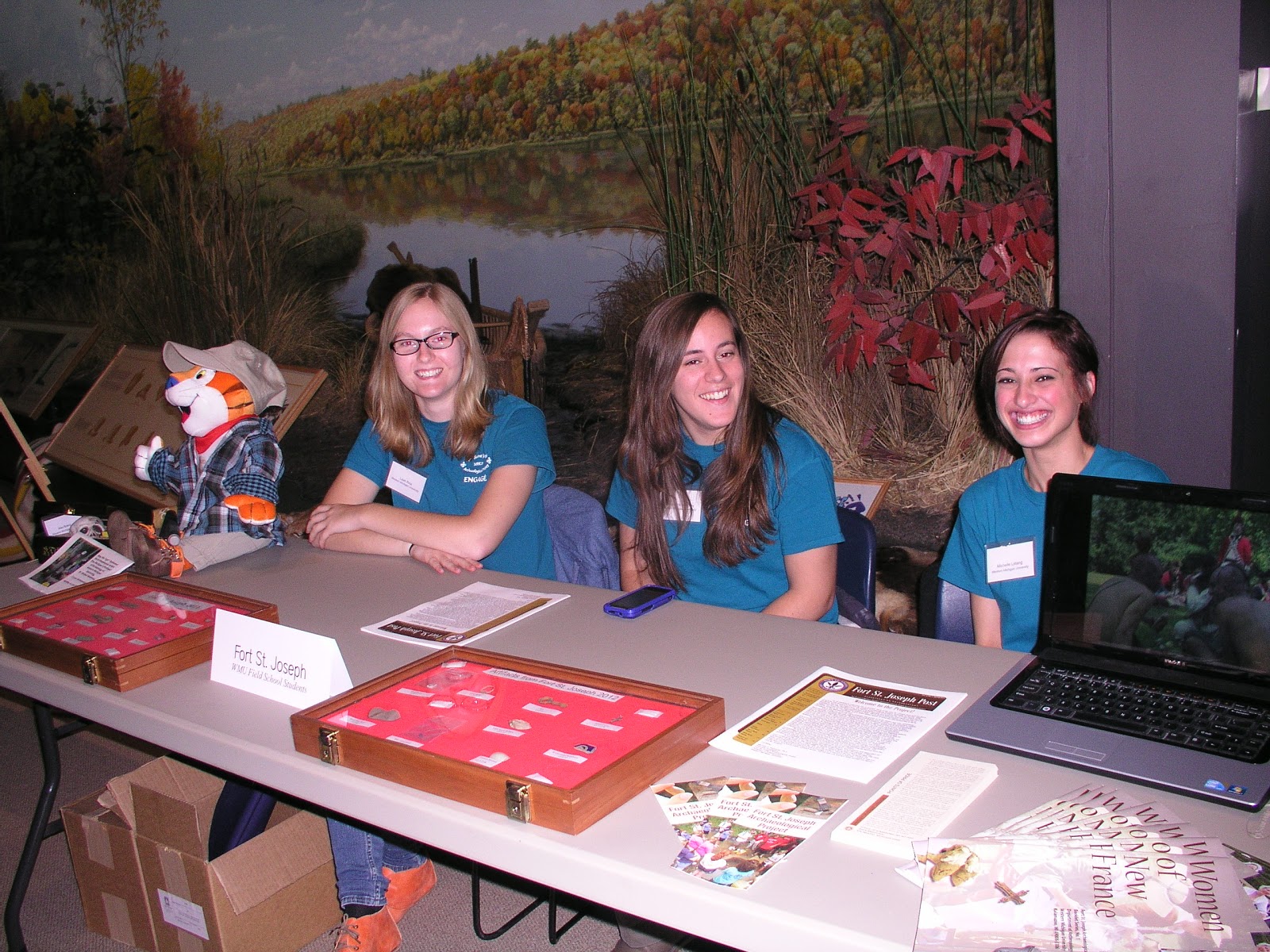
On Saturday October 6th, Fort St. Joseph joined Archaeology Day at the Historical Center in Lansing. Archaeology Day is a event where archaeological projects around Michigan came together to show the public their recent work and give updates on their archaeological projects. This year FSJ was represented by Leah Rice, Cassie Mohney, Skylar Bauer, our "mascot" Tony, and myself. Each group was stationed in the museum according to their topic, Fort St. Joseph was in the exhibit for French fur trade. 
This year we had about 500 people come to visit Archaeology Day, which also included presentations and demonstrations by various presenters. This year the public enjoyed talking to us about this past year's excavation and different artifacts that we found. They especially enjoyed the Women of New France publication. I found Archaeology Day to be a lot of fun and cannot wait to see what next year has to bring.- Michelle Letang
Tony, Leah, Cassie, and Michelle

Monday, September 10, 2012

Floating Samples: A Good Way To Start A Monday

Greetings folks!
Jordan and Leah floating soil samples.
       Today we floated soil samples that were collected during the 2012 field season. Flotation is just one of many methods used by archaeologists to collect more information about a site. We start by filling our Flote-Tech Flotation Machine with water. The flotation machine has a system of pvc pipes that connect to a small pump. The pvc jets gently push water up towards the surface, separating the light from the heavy fractions, as well as assisting in clearing out the soil. The light fraction consists of seeds, charcoal, and other lighter material. This light fraction floats to the surface and over to a separate screen area. The heavy fraction consists of seed beads, lead shot, bone, and a variety of other heavy materials. The heavy fraction remains at the bottom of a separate screen. Once the soil sample has been completely sorted by the flotation machine, they are set out to dry, and will be bagged and sorted into more detailed categories in the future. This process helps us, especially, to recover seeds that may be too small to find while excavating. We'll let you know later what we recover from them! 
      Today also marks the first day that our independent study students started their work in the lab! Students participated in both the flotation as well as entering data into past perfect (our database system). We have a tremendous crew this year, consisting of Leah Rice, Michelle Letang, Cassie Mohney, and Tabitha Hubbard. Each of our new lab crew members participated as students in the past field season, so you may have already met them! If not, they will be introducing themselves and updating you on their work in the future. Thanks for stopping by! We'll update you again soon!

              Alex 

Friday, September 7, 2012

Stay Tuned Folks! More Updates From The Lab Coming Soon!

Greetings!
This is me, supervising in the field....we'll go with that.
      We hope that you enjoyed this past field season as much as we did. We're back at Western Michigan University once again after a very successful two months of field work. Now it's time to start analyzing the data we collected and see what we can learn! There are soil samples to run through the flotation machine and sort, artifacts to inventory and evaluate, data to enter into our software system (Past Perfect), publications to put together, and, of course, start planning the next field season! A handful of students (and some old and new faces) will be working in the lab under the supervision of Dr. Nassaney and myself. We will continue to update you throughout the year on special events, lab goals and achievements, new discoveries, and other announcements and publications. Thank you again for your constant support and vested interest in the preservation of the past. We'll update you on a regular basis, so make sure you bookmark our site and visit again soon!

                 Alex Brand

Monday, August 13, 2012

Baby Bye Bye Bye

Hanging out before the Open House

            This past weekend the Fort St. Joseph crew held our annual Open House, an opportunity for people from the community and anyone else who’s interested in the fort to come out and learn all about the dig. There were also re-enactors, men and women who not only dressed up in period garb but also slept in tents in Riverfront Park, fired cannons, and prepared period food. It was an action-packed weekend full of plenty to do, and 1800 people came out over the two-day period to enjoy the activities and learn about everything we’d been doing on the site for the past five weeks.
Jordan welcoming guests to Feature 14
            Though I’m a bit skittish around strangers, I found that I had a BLAST this weekend. It was really exciting when I was down on the site itself and answering questions about our units and the fireplace that we’d uncovered for the public to see. Everyone who walked by was incredibly interested, and even though I probably talked quite a few ears off, I think that everyone who stopped by enjoyed the experience as much as I did. And that really surprised me. I’d heard the numbers from Dr. Nassaney – 2,000 visitors at the highest – and it was hard to believe. Not that many people I knew really cared about archaeology. I was happy to be proven wrong by everyone who came out this weekend to check out the site and all of the great work we’ve been doing.
Captain Leah Sparrow
            And while the Open House itself was incredible, I have to admit that one of my favorite parts of the weekend was the night we spent with the re-enactors. Leah and I headed over to the camp Saturday afternoon and were greeted with friendly smiles and a variety of drinks to choose from. One of the re-enactors, Stefan, showed us his British redcoat, and it wasn’t long before the both of us had costumes of our own. Leah and I made dashing voyageurs (though Leah looked more like she’d just stepped off the set of Pirates of the Caribbean 5). When the rest of the gang arrived, they too got all dressed up, and soon we were just as home in the camp as the real re-enactors were. We had a huge feast of period food laid out for us with meat pie, banana bread, potatoes and ham, and all sorts of delicious dishes. Then we were given the opportunity to work off our meal in some authentic period dancing, which to me still seems very similar to a square dance, which is the sort of stuff we learn in high school in upstate New York. Anyway, we had a blast with the dances (even if we got lost a lot) and the night got even more exciting when we participated in some tomahawk throwing. It turned out that a few of the girls were naturals, though almost everyone sunk their tomahawk once, including Dr. Nassaney himself. Though I didn’t get to throw much, I did get to fire a replica of an 18th century musket, thanks to a very cool re-enactor named Ramone. Sue got quite a few shots off too, and she sure looked cool!
            Unfortunately, our fun time with the re-enactors and the Open House weekend ended, as did today, our last day in the field doing archaeological work. Tomorrow we finish backfilling our units and packing up the site and the house where we’ve been living for the duration of the field season. And then, once all that’s done, we’re back to Kalamazoo. 
            It’s been a wild ride, and I just want to thank the whole Niles community for being so awesome; and here’s to all of those families who came out last weekend to learn more about archaeology and the old French fort that’s been the focus of excavation for the past ten plus years. Thanks for everything!

Sunday, August 12, 2012

Thank You Everyone!

Open House wrapped up today at 4 pm followed by a special canoe ride for the hard-working student archaeologists at Fort St. Joseph. Once again our event was a huge success. Visitor counts estimate about 1,800 people came to join in on the fun, some for the first time this year, many returning for a second, third, or fourth year and some even came in from as far as New Jersey (full disclosure: that's because they're my family). Our students were excited to share everything they've been learning this summer and were grateful for the opportunity to talk to so many interested people. We'd like to say a gigantic THANK YOU! to everyone who came out and helped make this event a success. Stay tuned, we have a  few more days left in the field and a few more exciting stories to tell!


- Erica


FSJ Archaeologists pose for a quick photo after an exhausting, but fun, weekend