Tuesday, October 22, 2019

Visiting the Mother Fort

Michael Nassaney delivering his CFCS presentation to a riveted crowd. Photo by Erika Hartley.
The Center for French Colonial Studies held its annual conference in Mackinaw City, Michigan, Oct. 4-6, 2019. This is an important place for French colonial aficionados because it’s the site of Fort Michilimakinac, the most strategic French trading post in the Great Lakes region. You might say it’s the “mother fort.” Indeed, archaeologists are drawn to it because it has been the site of continuous archaeological investigations since 1959—and they’re not done yet!

To provide some historical context, Jean Nicolet was the first documented French explorer in the Upper Great Lakes region when he passed through the Straits of Mackinac in 1634 in search of that illusive northwest passage to China. Father Jacques Marquette founded his mission at St. Ignace on the north side of the Straits in 1671. Sometime between 1679 and 1683 the French formally established a military presence with the construction of Fort de Buade, also referred to as Missilimakinak (Michilimackinac), in the same area. Lamothe Cadillac served as commandant of the post at the end of the seventeenth century, and the French stayed at the Straits after he departed to establish Fort Pontchartrain in 1701 at present day Detroit. The French moved to the south side of the Straits in 1715 and built Fort Michilimackinac where they officially remained until the end of the Seven Years War, surrendering the fort to the British in 1761.

A welcoming entrance to a French-style building at Fort Michilimackinac. Photo by Helen Crist.
Conference participants were treated to a behind the scenes tour of the reconstructed fort by Dr. Lynn Evans, Director of Archaeology for the Mackinac State Historic Parks Commission. In addition to seeing French-style buildings reconstructed precisely where they once stood, we also witnessed a wide array of artifacts from among the more than one million that have been recovered from the fort, along with preserved archaeological remains such as the burned roof timbers of the powder magazine that the British destroyed before moving to Mackinac Island in the late 1770s.

Saturday was filled with presentations about the archaeology (of course!), history, and genealogy of the French in the Mackinac region. Fort St. Joseph staff and supporters were well represented on the program and in the audience. Lynn Evans discussed some of the artifacts of religious devotion from Michilimackinac, a timely topic since Dr. Joe Brandão and I are currently studying the Jesuits and religious artifacts at Fort St. Joseph. James Dunnigan, a participant in the 2013 field season at Fort St. Joseph and M.A. candidate in Anthropology at WMU, discussed his research on the external village at Fort Michilimackinac. I had the opportunity to summarize 21 years of investigations at Fort St. Joseph, drawing on findings from our recent book, Fort St. Joseph Revealed (University Press of Florida, 2019). I closed by sharing some of the exciting work we conducted this past field season that revealed in tact deposits associated with the fort beneath the 20th century dump that deterred archaeologists for decades. Erika Hartley, the current Fort St. Joseph Curatorial Fellow, discussed the work we are doing to preserve the past for the future at Fort St. Joseph and why it is important to ensure proper curation of the archaeological collection.

The colorful Timothy Kent addressing the audience at the conference. Photo by Loraine DiCerbo.
After lunch, our friends and supporters from the French-Canadian Heritage Society of Michigan discussed what they have learned about their ancestors, including some people who lived at Fort St. Joseph and traveled throughout New France. The last two papers shed light on the Native peoples of the region, how they interacted with Catholics priests, and how they are currently reviving their language. The day ended with an authentic Native American feast followed by an informal yet informative presentation by Timothy Kent. It’s always a pleasure to hear Tim chat about his work drawn from (in his words) “original French documents, archaeological site reports, museum collections, genealogical research on more than 800 of my direct French and French Canadian ancestors, visiting and studying at each of the 137 ancestral communities in France, several decades of private living history research (focusing on the lives of a French trader of the seventeenth century and his native family), and paddling with my wife and two sons from end to end the 3,000 mile length of the mainline fur trade canoe route across the U.S. and Canada.” Tim visited Fort St. Joseph as a public scholar in 2011 when our focus was the fur trade and he hasn’t missed a beat in his knowledge and enthusiasm.
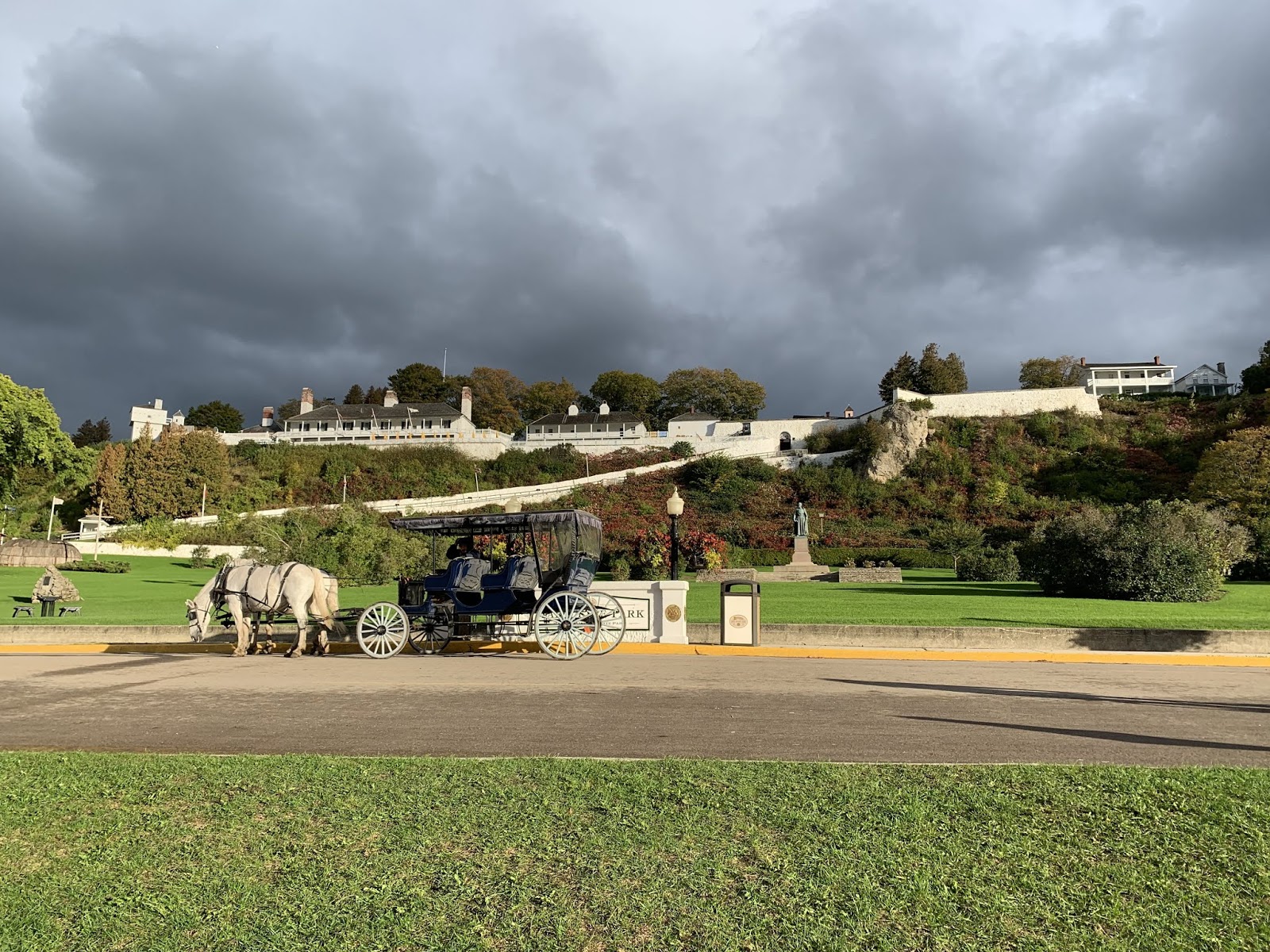
Fort Mackinac from a distance with menacing storm clouds rolling in. Photo by Erika Hartley.
After an exhilarating weekend, some of us still had the energy to brave wind and high seas to take the ferry to Mackinac Island to conquer yet another fort. The following morning before an early breakfast I ran into the intrepid travelers: Erika Hartley, Mary Ellen Drolet, Neal and Kathy Hassinger, and Lynn and Meryl Christensen. I’m sure Fort Mackinac and its personnel were able to withstand any affront these French sympathizers from Fort St. Joseph tried to wield.                                       
                                                                                                                                                                 Until next time,                                                                                                                                                Michael Nassaney 


Monday, October 7, 2019

Hangin’ Out at the Four Flags Area Apple Festival

"Mary Ellen & Erika Hartley, scrupulously identifying lead seals"

Hi Fort followers! This is Cece, here to report back on the fun happenings at the Four Flags Area Apple Festival in Niles. We really appreciated being a part of this event, that has been celebrating Michiana’s bountiful apple harvest since 1972!

Cameron and I set up camp in the Chapin mansion on Saturday morning with our artifact cases, t-shirts, brochures and booklets, ready to get people excited about the Fort St. Joseph Archaeological Project. Across from us sat field director and curatorial fellow, Erika, and fort supporter, Mary Ellen. They were working with a pile of lead seals, and a big old book on archaeological remains found at Fort St. Joseph written by Charles Hulse, working to get the artifacts properly identified, inventoried, and cross referenced. This process involved studying the worn lead seals for identifying characteristics, like tiny fleur de lis or letters stamped into the seal. From there, we could trace where the seal originated. These artifacts travelled from northern and southern France to our very own Fort St. Joseph, sometime during the 18th century.  
"The curatorial experience, in a first-person perspective"


"Wool spinning, live and in action!"
A couple of rooms over, there was a woman spinning yarn on a wheel, and another woman weaving fabric on a loom, educating people on the process of making clothes from sheep to shirt. Halfway through the day we were gifted Pizza Transit, highly esteemed among all of the FSJ students and staff. I was very happy to be eating those breadsticks again! 

The weather was rather rainy and gray so traffic in the mansion was light, but it was a great day reuniting with some of the community members and talking to folks about the project. After packing up, Cameron and I explored the fair grounds for a little while and went back to Kalamazoo with some beautiful apples. Now I am back in the lab, working on digitizing field notes from the past field seasons, and preparing for an upcoming visit to a local high school where we’ll be getting students interested in archaeology and Fort St. Joseph.  

Thank you as usual, for the lovely time, Niles!  


Thursday, September 19, 2019

Tirelessly Working on FSJ at WMU

Hi everyone! This is Lucy and I’m back again with a blog on our first few weeks back at Western! The work for Fort St. Joseph is never done, and this semester I get to do independent study with Cece, under the guidance of Dr. Nassaney and Cameron Youngs. Cece and I were both field school students during the 2019 field season, and we both decided to continue our work for Fort St. Joseph through independent study. We are just beginning to start the list of things we need to do this semester! Up to now, I have started working with Doctor Nassaney on an artifact inventory for the materials we collected from this past field season. Cece has started the process of recreating the Fort St. Joseph brochure, which we do every year after the field season. You will get to hear from Cece a little later in the semester! 
Like I said, Dr. Nassaney and I have started to create an inventory of the artifacts from this field season. This is a meticulous process where we must take out every artifact we have, count them, weigh them, and categorize them by material and function, to create an inventory for the 2019 field season. So far, we have gotten through one of the four boxes of artifacts, and we now have around 50 accessions logged! This process appears to be a lot harder and tedious than it actually is, and up to this point I am really enjoying this work. It gives me more perspective and knowledge about the artifacts we find at Fort St. Joseph. For example, throughout the whole field season, I had a hard time differentiating calcined bone from mortar, because they can look a lot alike. But throughout the inventorying process, I have been able to learn how to differentiate them with ease! I have also been able to see more of the artifacts that I was not able to see, or didn’t know we had discovered during the field season.  
Lucy wet-screening for artifacts during the 2019 field season.
Photo by Hannah Rucinski
Another task that I get to help with this semester is writing the annual report. The annual report is basically an overview of all the activities that have taken place pertaining to the Fort St. Joseph Archaeological Project. This includes all of our activities from the field school, our discoveries, the conferences that were attended, schools we have visited, the open house, our social media presence, and many other aspects of the project! I am excited that I get to help with this task, and learn more about some of the things we do and have done for this project. 
Overall, I am happy that I decided to enroll in independent study this semester. It keeps me involved with Fort St. Joseph, and has/will give me more experience in archaeology. Not only do I get to work in a lab setting, but I also get to make more of a mark on the project! 

Monday, September 2, 2019

From the Field, and into the Lab

Hi everybody, this is Cameron coming back to you as the new Fort St. Joseph museum intern. Over the summer I was the field assistant for the project, where I supervised and assisted the field students. But after the short two week break between the field season and the fall semester, I was accepted to continue working for the project, as a liaison between Western and the Fort St. Joseph Museum. 
My role is to essentially work as a lab manager at Western, to oversee the work that is being done by independent study students, to promote the project at public outreach events, and to work with the Museum by integrating artifacts into their collection. As many of you know the theme of this year’s field season was curation. And that is the step that we are currently beginning to start. Only a small portion of archaeology is spent in the field recovering artifacts. Most of it is spent on the curation process. We will begin by counting, and weighing artifacts by material type. Then this information will be entered into a digital inventory list, and the artifacts will be organized sequentially in a box, ready to be integrated into the collections back at the Niles History Center. 
Two students are returning from the field season for independent study, and I am going to meet with them this week to assign their roles, so we may begin working immediately. They will be assigned to start working with Doctor Nassaney on the artifact inventory. I did this last year as an independent study student, and it will allow them to acquire skills in artifact identification, general lab work, and the curation process. And between independent study and the summer field school, these students will acquire a valuable set of skills that will guide them in their future.
So after we begin our work this week, and the students get acquainted with their new roles. You will be hearing back from one of us again shortly. They will be sharing their new experiences with you, whether it is an update on their progress in the lab, or about a public outreach event. And hopefully we will see some of you at one of these events. We will also be posting pictures from this past field season on facebook, including images of some of our recent discoveries!

So until next time,

Cameron