Wednesday, August 16, 2023

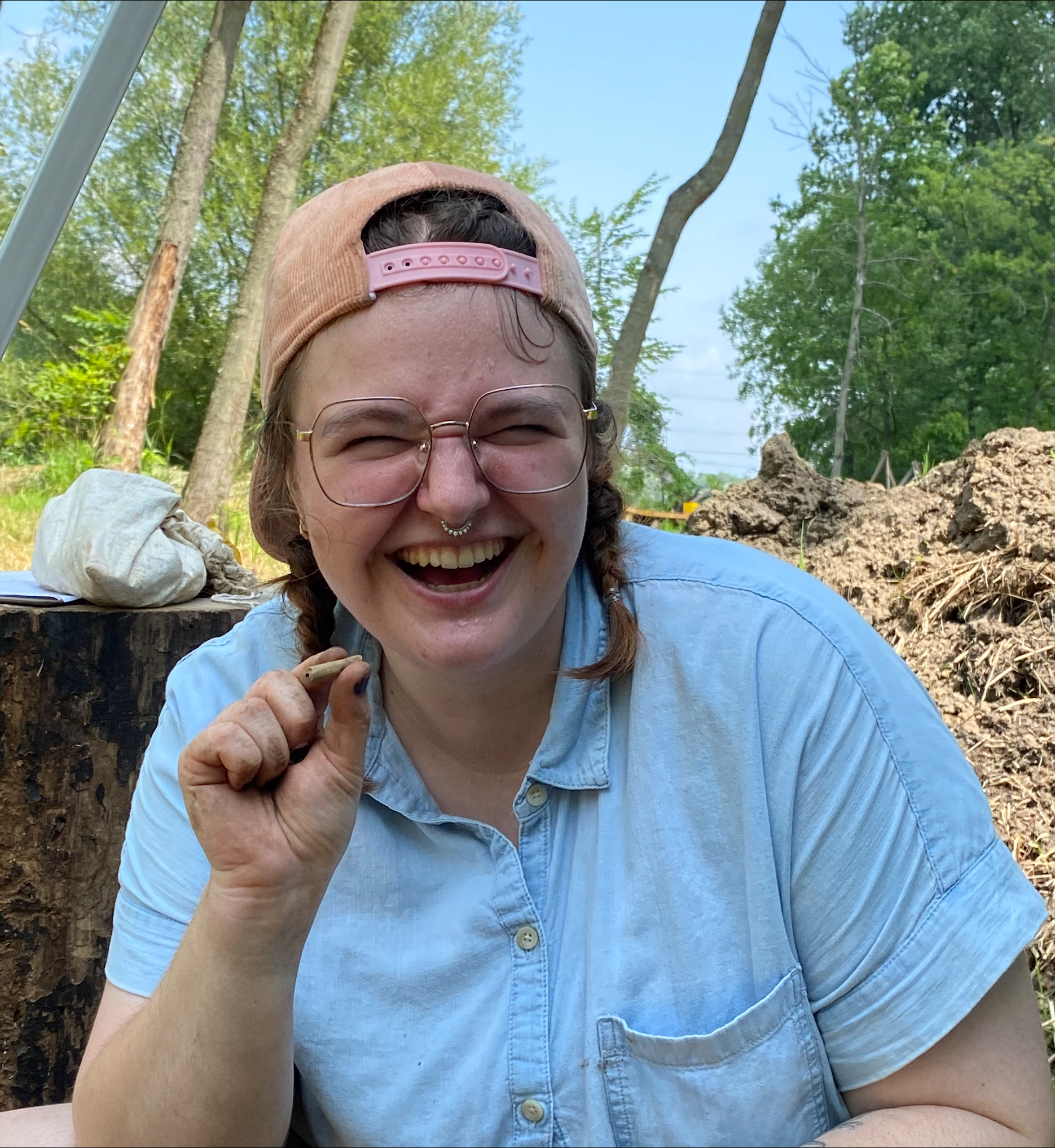
What’s that? A bone? No, it’s just mudstone

Fort Followers,

A common occurrence here at the Fort St. Joseph field school is uncovering mudstone. Due to mudstone’s non-uniform shape, students new to the site can confuse it with artifacts, especially since it is made up of silt and clay. When finding mudstone, especially red or orange colored mudstone, it can be mistaken for a piece of dried or baked clay. Mudstone can sometimes appear to look “flaked” or “chipped” at, so a new archaeologist in training might think it could be a flint flake or even a projectile point. My classmates and I come across mudstone often and at first believed it to be other things. As a result, I thought it would be fun to research and write about what it is. 

According to the University of Auckland’s Geology page, mudstone is a sedimentary rock made of silt and clay. It describes mudstone as presenting itself in various colors like brown, black, red, grey, etc. We have mudstone at the Fort in all these colors, including some that look more orange than brown. From the website, World of Stones, it is described that when finding mudstone that is black or grey, it suggests that there is organic content. The organic content typically is due to natural gases and oils. If you were to find green, brown, red, or yellow mudstone, this would indicate the existence of iron oxide in the stone. 

World of Stones contains more information including that the chemical compound of mudstone is NaCl, CaO, Aluminum Oxide, Iron (III) Oxide, and much more. According to the website, mudstone can be located all around the globe. Continents that have mudstone include Europe, Asia, Africa, the Americas, and Australia. Mudstone is typically located near waterways, which makes sense because we are located right next to the St. Joseph River. There is also a lot of clay and silt in the river, which helps to be responsible for the creation of mudstone.

Now you may be asking yourself, “Is mudstone important?” or “Can mudstone be used for anything?”, The Geological Society helped provide me with that answer, YES! On their page, the Rock Cycle, they include mudstone being used for pottery, cement, brick roofs, and tiles. Going back to the World of Stone, they wrote that mudstone could be used as a stone veneer, pathways, stepping stones, tiles, etc.

When excavating at Fort St. Joseph, finding mudstone can be disappointing when it comes to wanting to find 18th-century artifacts. But when looking at mudstone from a different view, it is really cool. I find it really intriguing that mudstone can look completely different from each other, but be considered the same thing. It is really neat that nature makes these odd but pretty-looking rocks. 

The 2023 Fort St. Joseph field school will not be the last to uncover mudstone at the site or in the world. But I am hoping that by reading this blog, people will have a better understanding of what mudstone is and that it isn’t just a “stone”. 

Korrin 


References: 

“Mudstone Uses.” The Geological Society, www.geolsoc.org.uk/ks3/gsl/education/resources/rockcycle/page3528.html. Accessed 14 Aug. 2023.

“Mudstone – Meaning, Uses, Facts, Properties & Color.” WorldofStones, worldofstonesusa.com/blogs/all/mudstone#:~:text=Chemical%20Properties,Silicon%20Dioxide%2C%20and%20so%20on. Accessed 14 Aug. 2023.

“Mudstone.” Geology - Rocks and Minerals, rocksminerals.flexiblelearning.auckland.ac.nz/rocks/mudstone.html#:~:text=Mudstone%20is%20an%20extremely%20fine,clay%20and%20silt%2Dsized%20particles. Accessed 14 Aug. 2023. 

An unforgettable weekend!

Hey there guys,

        Last weekend we celebrated twenty five years of archeology at the site and held the annual FSJAP open house! It was a great time for everyone involved despite the weather not cooperating. One of my favorite booths was the one about zooarchaeology. Terry, the resident zooarchaeologist, brought out a ton of bones from throughout the years and some that my fellow students helped identify. One of the coolest bones at the booth was the bald eagle bones. The bone was so rare at the fort that Terry had to go out of town to confirm the species. Talk about an amazing find! 

The open house offered a lot of activities for people to do and it took a lot of people to run it smoothly. Long time volunteers like Mary Ellen, Gary and Gordon, previous field students like Kylie and Chloe, and even volunteers from organizations like the DAR and Support the Fort. Without the people and organizations who came over and shared a few days with us at the site the operations and events would have been too much to handle. I would like to thank everyone that volunteered at the open house and encourage others to volunteer next year because it’s a great time. 

This year the archeological project celebrated its twenty-fifth year as an ongoing archeological project. Twenty-five years of finding small pieces of bone. Twenty-five years of mistaking mudstone for previously mentioned bone. Twenty-five years of connecting history to the present. And most importantly twenty-five years of working with the community. In my time as a student here at Fort St. Joseph, I have had the pleasure of interacting with the local community a few times and the open house was a great time to meet more members. Even though it only lasted two days, I got to talk and joke around with countless people from the area. From living history reenactors to people who had never heard about the fort before, everyone was extremely kind. I led a few historic walking tours and many of the people who had attended my sessions knew a plethora about the local history and would tell fun anecdotes about playing around the commemorative rock and surrounding woods. I just loved seeing how recovering the past can bring people together through the open house. Seeing just how much everyone was genuinely interested in the site and how it made them think critically made me realize how important archeology can be. All in all, the open house this year was nothing short of amazing. I would like to thank everyone who came out, volunteered, and spread the word. This incredible event and milestone would not happen without your support. 

- Ian

Tuesday, August 15, 2023

Forts, Poor Farms, and Logging Towns: The differences between 18th and 19th Century Material Culture


Hi everyone!

My name is Michelle and I am one of the field interns working on the site this year. I am a senior anthropology student at Grand Valley State University and have experienced two field schools through the anthropology department there, both of which being 19th century sites! The artifacts there are a bit different than the ones found at Fort St. Joseph, so let's go through the differences in material culture and my experiences at these other sites!

Material culture can vary depending on the time period you’re excavating. At Fort St. Joseph, you will find 18th century artifacts whether it be construction debris or items left behind by artisans and residents of the fort. Some of the material culture in this area and time period show the importance of trade and industry in the 1700’s. Seed beads, remnants of blacksmithing, and lead shot are some examples of artifacts recently uncovered on site. Material culture looked a lot different in the 1800’s due to industrialization creating a greater variety of items. In the 19th century many small towns began to pop up in the western Michigan region, especially along the Grand River which is where I am talking about today.

In 2021 we did a field school at Eastmanville Poor Farm, which is now a state park with walking trails and a historic barn. Poor farms were built to be a home for the poor and mentally ill before government assistance was available. Our goal was to locate the “Midway House'' which was one of the first structures built in the area to act as a resting place for travelers. Built in the 1860’s and torn down in the 1950’s, this building has seen a lot of history. We have records that this building was once used for patients and residents of the farm until a secondary building was constructed. We set up units on the foundation and perimeter of the house and we found a lot of construction debris such as red and yellow brick, window glass, and even a stove foot. An interesting thing to note is the vast variety of nails found in the wreckage. Since the building stood for almost 100 years, they used different nails over the years, from square handwrought to the smaller mass produced varieties. In addition to these constriction materials we found some trash of the time period. Back then their trash looked a lot different to what we would think of today. Broken watch gears, pots, and even some scraps of fabric may have been thrown out the back door or window of the house, and we may have found where they dumped ash buckets outside as well. Even trash in the archaeological record can be interesting!
        
        Here is an example of a stove foot; the
        stove sits on the metal plate to displace heat.
Broken pot found in my excavation unit.


White buttons like this are the most common in the collection.
In 2023 the field school was held in Blendon Landing. Blendon Landing is an old logging and shipbuilding town which was most populated in the mid 1860’s and was abandoned by 1912. Grand Valley has held many field schools there since 1969 due to its vicinity to campus and since the University owns the land. All that remains of the town is a forest and a scar cut into the ground which used to be a logging rail line. A lot of the material culture found were construction materials and housewares. Whiteware, bottle glass, and buttons can provide insight into the daily lives of the residents. We found a broken horseshoe which shows that they had livestock. This confirms our knowledge of the area being turned into farmland after the town was abandoned. Field schools over the years have yielded a lot of buttons from the site. Buttons of the time vary a lot depending on socioeconomic status and materials in the area. In the 18th century buttons were most commonly found on mens uniforms as a sign of status. (Copper uniform buttons have been found this year) In the 19th century the variety of buttons increased due to industrialization. Glass, shell, metal, and even rubber buttons become commonplace in all sorts of garments. Fancier buttons are signs of wealth so it is interesting to see how much we can learn about individuals from such small items.

The main thing I find so interesting about the differences in material culture at these sites is how much it can tell us about the people that used to live there. The level of consumerism is so different between these two centuries, you can imagine how different their lives must have been. The stories told from the mundane are some of the most interesting to me, there is so much to be told from broken pieces of pottery to the smallest seed bead. If anything, my time here has solidified my love for dirt, rusty nails, and seed beads no matter how numerous they are.

See you out there! 

-Michelle Oberlin

Monday, August 14, 2023

Stems and bowls and pipes oh my!

Hello fellow archaeology enthusiasts! 

It’s Hollie again from unit N10 E3. It has been a great few weeks out at Fort St. Joseph Archaeological Project and things are about to get even more interesting! As we are making our way through the plow zone toward the occupation zone, we are uncovering more and more 18th century artifacts. We have been particularly excited to find fragments of clay and stone pipes over the last couple of weeks. While excavating and wet screening our unit, Emma and I were fortunate enough to find 4+ clay pipe stem fragments as well as a pretty large piece of a stone pipe bowl! Several others at the site, classmates, campers, and volunteers, have also discovered clay pipe stems and an additional piece of a stone pipe bowl. 

Though not an overly uncommon find at FSJ, pipe stems can tell us more than one may think about this historic site. Pipe stems are, like their name suggests, the stems of smoking pipes used for recreational and spiritual smoking of tobacco and other substances. First crafted and used by Indigenous Americans, Europeans began crafting their own clay pipes during the early 1600s. It appears that the pipe stems commonly found at Fort St. Joseph, and in unit N10 E3 specifically, are of European, not Indigenous American origin. The white clay pipes crafted by Europeans were less expensive to produce than obtaining Native American-made clay pipes but have been found to be more fragile than those of their Native counterparts. Those excavated so far this summer have been from the plow zone and range from around 1 to 4 centimeters in length. It is likely that the somewhat fragile pipes were broken, or further broken, by the plowing that took place in the area. These pipe fragments are particularly interesting because they can tell us not only about the social and spiritual practices of local Indigenous peoples and occupying Europeans, but about the age and occupation of the fort itself. 

Upon initial observations, the pipe stems appear quite similar in appearance; however, the fragments of clay pipe stems excavated at FSJ all have one feature key in distinguishing them from each other, and perhaps more importantly, from other pipe stems not found or less commonly found at the site. This important feature is the bore hole going through each of the stem fragments. Archaeologists have been able to determine that the width of pipe stems holes corresponds to the years in which they were manufactured. Additionally, the hole sizes can help tell us if the pipes we are finding were locally traded items or ones imported from Europe. Though it cannot account for the exact duration of years in which the pipes were distributed and traded, this system of dating played an important role in initial dating of Fort St. Joseph.   


Stone pipe bowls are thought to have increased in popularity during the early 18th century, perhaps in response to the fragility of European made clay pipes. Interestingly however, stone pipe bowls have been a significantly less common find at the FSJ Archaeological Project thus far. The stone pipe bowl pictured is the one Emma and I found in the west wall of our unit on Thursday, July 27th. The wisdom of Dr. Michael Nassaney, alongside additional research, has revealed that the fragment belongs to a Micmac style pipe, likely originating from Maine or northeastern Canada. Unlike the pipes previously mentioned, this pipe bowl was not equipped with an attached pipe stem. Instead, it would have had a separate wooden, often highly decorated, detachable stem. Micmac pipes were more distinctly spiritual than clay pipes made and used during the same time. Said pipes were initially used amongst the Mi’kmaq people only with nonrecreational herbal blends and tobacco for spiritual ceremony. Later, as the pipes were adopted by Europeans and other Native American groups, their original spiritual intentions became blurry. They were increasingly used for recreational purpose, forgoing the strong ceremonial emphasis of the Mi’kmaq people. They additionally became more ornate as their popularity grew, losing their humble spiritual beginnings. 

The pipes are thought to have originally symbolized the balance of peace between man and woman and between nature and human interactions. As they gained popularity however, their meaning evolved to a more generalized symbol of peace, particularly between native groups and between Europeans like those at FSJ and Native American locals like the Potawatomi. It is additionally believed that smoking stone pipes in the presence of each other indicated cordial relations. The presence of Native American made pipes at Fort St. Joseph provides further evidence of trade and relations between local indigenous groups and the European occupiers of FSJ. 

- Hollie

References 

Muin’iskw, & Crowfeather. (2016, March 25). Mi’kmaw Spirituality- The Sacred Pipe. Mi’kmaw culture - spirituality - the sacred pipe. https://www.muiniskw.org/pgCulture2f.htm 

McMillan, Lauren K. (2016) "An Evaluation of Tobacco Pipe Stem Dating Formulas," Northeast Historical Archaeology: Vol. 45 45, Article 3.

Rafferty, S. M., Mann, R., & Nassaney, M. S. (2004). Ch. 4- Men and Women, Pipes and Power in Native New England. In Smoking and culture: The archaeology of tobacco pipes in eastern North America (1st ed., pp. 125–141). University of Tennessee Press. 


Excavating to Answer Research Questions

Hi everyone, 


    My name is Emma Maher and I am a junior at WMU majoring in anthropology and minoring in public history. Over the past few weeks my partner Hollie and I have been excavating our unit, located at N10 E3. We have been finding many exciting artifacts such as lead shot, various types of beads, window and bottle glass, nails, wampum, pipe stems, an upholstery tack, part of a stone pipe bowl, and lots and lots of bones.


You might think we just got lucky to be finding these things, but in reality, choosing where to start digging is a decision that requires some careful thought. When we were all looking at where to place our units, we had to consider where past units were and what they found as well as consider what specific question we wanted to answer. While many of our fellow students were interested in finding the boundaries of the site to help answer the question of how far Fort St Joseph extends, Hollie and I were interested in the previously located Feature 27, a fireplace. We want to see how far the fireplace extends and whether there is in fact another structure around it. 


    In 2018, the units N9 E0 and N9 E2 were opened in order to explore Feature 27. So far, the artifacts that Hollie and I found are consistent with those that were previously found in these units. While they were able to expose even more of Feature 27 and make a reasonable assumption that it represents another structure (Structure 6), there are still many unanswered questions about this area of the site. We hope to be able to find archaeological evidence to provide more information about this area and what it was used for, including further evidence of Structure 6.

Stay tuned for more updates! 

Emma

Monday, July 24, 2023

Fun First French Find

Hi Fort Followers,

On the second day of digging on the site, I happened to be searching for some cool rocks while my unit partner, Kieran, shovel skimmed. As I dug through the dirt Kieran lifted, I found three interesting rocks. I rinse them off and notice something intriguing about one of them. It appeared to have marks on it that resemble it being chipped away at. The marks seemed more human-influenced rather than a natural occurrence, so I asked my professor about it. Sure enough - it was an 18th-century gun flint! 

The flint is a honey-brown color, with a circular shape and a flat, smooth surface. One end of the flint has been chipped away at, creating a slightly flat edge. After doing some research, I discovered that this type of gunflint is called a spall-type gunflint, which is made from a large flake (or “spall”) knocked off a module of flint. Spalls refer to the shape being as wide as it is long. While it is the easiest to make, it is not as efficient.

Another detail to take note of is the color. As I mentioned earlier, the gunflint is a beautiful honey-brown color. Flint/chert of this color typically comes from France, while dark grey flint is produced in Britain. This shows the influence the French had at Fort St. Joseph during the 18th century.

After hearing all of this information, you may be wondering - what does a gunflint do? In a flintlock (a firearm with a flint-striking mechanism), a gunflint is typically held by the flintlock jaws and cushioned by a piece of cloth or leather. The flintlock jaws are a piece of the gun that holds the flint behind the frizzen, which is an L-shaped piece of steel hinged at the front. When you pull the trigger, the flint hits the frizzen and scrapes off the iron to produce sparks. The frizzen is also struck back by the hammer to uncover the gunpowder in the pan. The gunpowder ignites, and it travels through a small hole in the barrel’s side to set fire to the gunpowder in the barrel. While this sounds like a long, confusing process, this all happens in a matter of seconds. Usually, a flint is good for around 20-30 firings before it deteriorates, so soldiers were expected to carry several spare flints with them. 

Finding this gunflint in our unit was an awesome feeling. Being able to uncover a piece of the past and rewrite its fate of being buried underground forever is a big accomplishment for me. Not only was I proud, but also very shocked to find it. I got very lucky and happened to stumble upon an artifact while looking for cool rocks. If you decide to participate in excavating someday, I have one tip for you - make sure you check every stone you find! You never know what you could discover.

- Alivia

Sources:

Brain, M. (2000, April). How Flintlock Guns Work. HowStuffWorks; HowStuffWorks. https://science.howstuffworks.com/flintlock2.htm#:~:text=When%20you%20fire%20the%20gun,the%20gunpowder%20inside%20the%20barrel

Samson Historical. (2023). Original Gun Flints. Samson Historical. https://www.samsonhistorical.com/en-ca/products/orginal-gun-flints


Beads, Beads, and More Beads!

Hi everyone,


If I were asked to say what makes Fort St. Joseph such a great site, I’d say it gives people a chance to literally hold history in their hands. For me, the chance to hold history in my hands has come in the last few weeks at our unit; good ol’ South 7 West 19. Though we hadn’t initially found more than a cluster of roots and one very imposing plant- which has been officially removed from the unit 😊. One of the largest variety of artifacts we’ve uncovered has come in the form of beads! Yes, I know, “What’s so special about beads?” you ask. While they aren’t the only kind of artifact we’ve recovered, I thought this post would be an excellent chance to shed a little more light on their cultural significance, such as their purposes as personal décor or valued tradables, just to name a few. 

Now, for those of you who don’t already know this, Fort St. Joseph has no shortage of beads which have served as continuing, supportive evidence of the historic economy between the French Traders and local Indigenous groups. What you might not know (unless you’re a curator or have spent time at the lab) is that there are literally tens of thousands of them which have been recovered... and very likely hundreds of thousands in total! From crinoids (a fossilized prehistoric plant material turned into a bead) to glass beads (typically used in fashionable neckwear or other kinds of jewelry) to the very smallest of seed beads (largely filler for personal attire or stylized accoutrements), the variety never truly ends and our site has several of each! 

Last week, my pit partner noticed something of particular interest in our Northeast corner... What it turned out to be was an especially interesting adornment item made of pipestone (or at least half of one!) This really made things interesting because of the scarcity of relevant artifacts at our unit prior to that point, so this was a tremendous morale booster that kept our focus sharper than our trowels. We’re definitely looking forward to more discoveries at Fort St. Joseph and history to hold in our hands!  

See you at the Wet Screens!

- Nick Harvey