Thursday, July 26, 2012

These Hands


           Ground was broken today, for the first time this season, at the Fort site. We will be moving our work there from the Lyne site on Monday and we will all finally begin the archaeology that we have so longed for. However, before we can move our work to the Fort site we have to finish our work at the Lyne site. This meant that every pair of hands was working feverishly with a new fire of aspiration lit under the archaeologist attached to them. Today, these hands, the hands of every person working in the Fort Saint Joseph Archaeological project excavated with an accurate intensity and the goal of digging the fastest and hardest they have yet. We’re going to finish these units and we’re going to dig the Fort.
            Where did we leave off from yesterday when we started these units? Less than twenty centimeters down!? It’s go time. These hands are ready to move. With a newly developing muscle memory this work is becoming second nature and we’re prepared to make it the last twenty centimeters by the end of the day. A challenge that we’re all up to; digging hard and digging well.
            Shovels and trowels working in a flurry, removing a centimeter of earth with every shovel-full. Buckets filled with soil faster than we were able to screen it. One person digs and the other screens. A non-stop flow of Archaeology ensued. Like the workers on the Henry Ford assembly line, our hands moved with skill in a new effective system of constant activity. Before you know it, you’ve finished your level and are ready to begin mapping.
            Measuring tape and levels. Make sure the floor is even. Put those fingers to work at clipping away those last few roots and mapping in the ones too large to take out. What’s the soil matrix? Note the change in the color and texture. Are we already that deep? Make your measurements precise and don’t miss a thing. Just because we’re working fast doesn’t mean we can be sloppy. Note the artifacts we’re finding; a handful of flakes, a few nails, bits of charcoal, some fire-cracked rock. Jon and Sue found some iron and lead shot! That’s good, but don’t get distracted. The paperwork is approved! Get more paperwork and get ready to go down another level. Back to digging.
            After an hour of repetitive motion, your hands seem to form to the handle of the shovel, of the trowel, of the handle on the 1/8 inch dry screen. Eyes are constantly scanning while hands are constantly moving. Is that a culturally significant piece of altered stone, or just a beautiful example of a Michigan pebble? Bag the flakes and don’t miss a thing. The buckets are filled with soil again and need to be screened! You can’t dig if you have nowhere to put the dirt. Bucket after bucket, your hands and eyes work independently of one another in a Zen-like state of artifact searching and identification. Did I miss anything? Re-check and then re-re-check. After all of this it is easy to lose sight of the big picture, of the significance of what exactly it is you are pulling out of the earth after hundreds of years of laying motionless and unseen.
            And then you find it; an artifact that takes your breath away and causes your heart to skip a beat. For me, it was the tip of what is possibly a bi-facially chipped projectile point or stone drill. For Sue and Jon it may have been the projectile point that was discarded mid-production. For Adam and Annie it may be the bullet casing that had visible English printing on it. You see the excitement of other peoples’ faces when they get to see and touch what you just pulled out of the ground. These were made and altered by human hands hundreds of years ago just like our hands working so eagerly to recover what may have just been cast aside.
            At these moments, you take a step back, you give your hands a rest, you take it all in and remember the significance of what it is your hands are doing and touching. We are finding objects that time had forgotten and bringing them back to life and relevance with our own amazement, interpretations, and wonder. The excitement takes you once again and you return to your work with a new zeal and respect. You now have in mind the feeling of what a single artifact can give you and your mind begins to race with the thoughts of the amazing things we have yet to uncover within the Fort site. Monday couldn’t come fast enough. 

Wednesday, July 25, 2012

How Many Archaeologists can you fit into a 1x1 meter unit?


Who would have ever thought of this question?  Well, in case you ever wondered, we have proof that it is 5!  However, there is talk of a possibility of 6, so stay tuned!  It’s Wednesday of week 3 and many of us have closed out our first unit and just opened up our second.  It’s also noticeable that everyone is getting on the goofy side, which makes this even more fun, but we remain focused. 
5 Archaeologists fit into a 1x1 meter unit
Cassie, Tabitha, Erica, Michelle and Leah


Many of us found quite a few items in our first units at the Lyne site, but the last 20 cm were quite lacking in artifacts.  I hadn’t been at the site for two days and it was strange to see my unit that I had worked on with my pit partner, Jon, all filled in.  Actually, it was kind of sad; it’s like moving from your first home to another home, the first one is always special.  After the units are all documented, photos are taken and when all the paperwork is done, each unit is filled in.  It was exciting that we were assigned a new unit to begin just about 15 meters off the river.  Wow, riverfront property, the high rent district.  All the excitement of opening up our first unit started all over again as we laid out our second unit.  It went much quicker this time and within 30 minutes we had our unit all measured, string line completed, datum line tied on, all beginning measurements taken and we started in with shovel skimming.  This didn’t last long as the amount of roots in our unit increased and using a trowel was the best way to go. 

Within our unit we found 27 stone flakes, and we’ve only gone down 10 cm. Jordan and Scott found the first musket ball of the season.  The life-long campers came in after lunch to start their units and many of them joined us at our units and gave us a hand.  Our camper, Jill, learned quickly how to start identifying stone flakes, way to go Jill! 
Jordan holding their musket ball, the first one found this year!
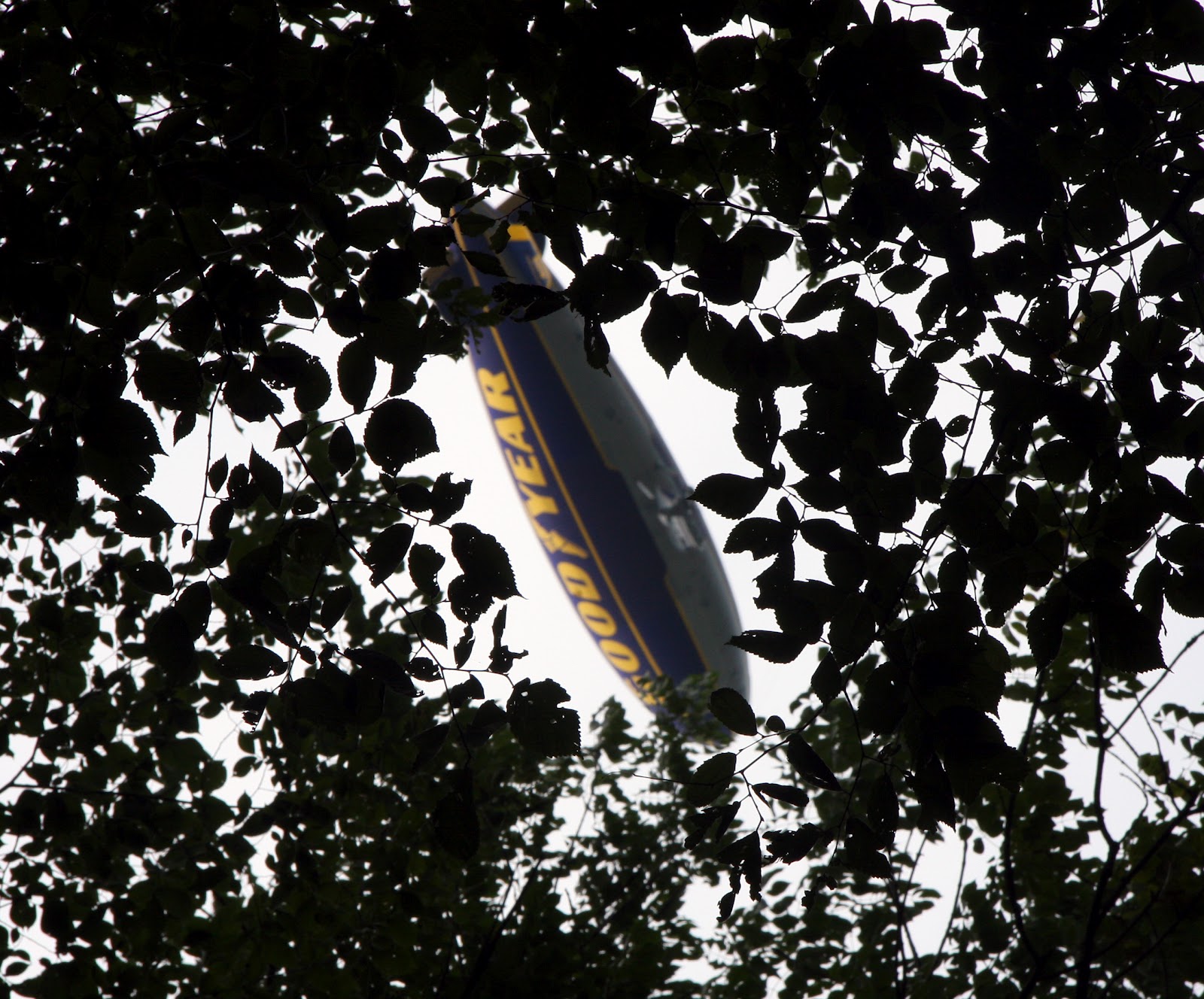
We had about a 30 minute rain delay as a rain storm came through and we got to the cars just in time, great timing!  Right after lunch we heard some strange noise and looked up and we had the Goodyear Blimp overhead, what a contrast to us digging up 17th century artifacts.   


The Goodyear Blimp visits Fort St. Joseph

Coming through town we noticed the new sign that is up over downtown advertising our Open House that is being held August 11-12, Niles does a great job of supporting us which is evident every day from the great people here.  

The Fort St. Joseph Open House Sign in downtown Niles.  Great Advertising!


Also today was our second Speaker Lecture Series, Mr. Larry Horrigan titled “Firearms of New France” dressed in 17th century Voyageur clothes, Mr. Horrigan spoke to a large crowd at the Niles Library and shared his extensive knowledge of the history and how the flintlocks were used. 


Mr. Larry Horrigan speaking on the “Firearms of New France”


Tomorrow should be another exciting day as we head back into the field, let’s hope the rain cooperates and comes when we’re not in the field.
Sue

Tuesday, July 24, 2012

To Dig or Not To Dig...


At Fort St. Joseph Museum
In the ballroom at City Hall
            We woke up this morning to rain pounding on the roof and dark ominous clouds lingering over Niles preventing us from going into the field. The morning ended up being occupied with watching “From Moccasins to Main Street,” a movie about the Great Sauk Trail, known as US-12. Dr. Nassaney makes a movie debut in the film. Fort St. Joseph Museum was next on the list of rainy day activities. Wandering through all the artifacts collected, there were actual pictographs drawn by Sitting Bull. There is a good collection of Fort St. Joseph artifacts on display along with a possible diagram of what the fort may have looked like. The Chapin Mansion, also known as City Hall, was next on our tour. The Chapin Mansion was erected in 1882 and was later bought by the city for $300. The mansion has beautiful stain glass along with a ballroom we were able to explore.
Calvin and Jon filling a pit
         
   The rain gods were kind to us and in the afternoon we were able to go into the field and inspect our pits. Most pits are being closed and filled once the paperwork is complete. The paperwork includes a full summary of who, what, when, where, and how of each pit. It includes the soils, artifacts found, the methods, etc. Two pits are still digging; one pit is still finding flakes! My pit, we are pretty sure, has reached the sterile zone. We are just leveling at 50 cm below datum then closing it up.  Once a pit is filled, the next pit at Lyne can be started which we are hoping to start soon. Campers made their appearance later in the afternoon to lay out their pits. The campers this week are life-long learners. It will be nice to be able to give them tips like were given to us the first week of our field school.
Tabitha and me leveling our pit 
At Lake Michigan, Weko Beach
 For dinner, we were hosted by Barb and Craig Schwaderer, who take part in history reenacting. A delicious meal of smoked chicken with bean salad was provided and thoroughly enjoyed. To our delight, they live about a ten minute walk from Weko Beach. Soccer ball in hand and swimsuits on, we headed to the beach to enjoy the beautiful sunset on Lake Michigan. The water was so warm and a large group played free-for-all with the soccer ball. Once the sun has set, a trumpet plays taps to signify the end of the day. A wonderful way to end a busy day. 

Cassie

Public Lecture 7/25!

Remember to join the Fort St. Joseph Archaeologists at our lecture series. Tomorrow night's presentation will be by Larry Horrigan titled "Firearms of New France" which will discuss the history and use of flintlocks in the 17th and 18th centuries. Larry will also have replicas on display. The talk starts at 7pm at the Niles District Library, we hope to see you there.

Monday, July 23, 2012

Third Week's The Charm!


Tabitha and Cassie demonstrating proper mapping techniques
Today marks the beginning of the third week of the 2012 Fort St. Joseph Archaeological school.  We had a lovely drive into Niles from Kalamazoo this morning and the weather couldn’t have been more perfect.  When we arrived in Niles at 9:15am it was 85 degrees, sunny, and starting to prove that it couldn’t have been a better day to be out in the field.  Everyone is starting to understand that they can’t bring everything they own and that made packing the van extremely painless for the first time. 

Doctor Nassaney conducted our weekly meeting and everyone is starting to really open up to each other. This field school has been great so far because we get to actively learn while being outside of the classroom.  In a classroom setting, the teacher is the “head honcho” and is responsible for presenting the learning material.  Out in the field, everybody is able to bring their own knowledge to the table.  This creates an environment that is judgment-free, open to anyone’s opinion, and really lets an individual come to their own conclusions.

Mary Ellen and I working hard on mapping our unit's profile
We are all currently in the stages of finishing up our first units and completing all the necessary paperwork.  My pit partner was unfortunately unable to make it today, but she was still with us all in spirit (WE MISS YOU SUE!).  I had the pleasure of working with Mary Ellen today and we were able to complete a lot of our paperwork today.  We always arrive to the field Monday mornings a few hours later than we do the rest of the week so it was a short work period before lunch today.  Mary Ellen and I were able to finish up most of our unit’s profile today.  A profile is a way to capture exactly what an individual unit’s stratigraphy looks like.  This is important because it is an exact replication of what we are looking at so if someone in the future wants to know what we did, they are able to look at our data and be able to re-create/envision exactly what we were looking at.  This takes a lot of careful mapping and descriptive writing.  Every little detail counts and it’s very important to be as precise as possible.
Dr. N showing us alternative uses of a trowel

Lunch was a real treat today because Dr. N showed his field school exactly how dedicated of an Archaeologist he really is.  If most of us were lacking a spoon and had some yogurt to eat, we’d probably save it for later. Not Dr. Nassaney; not our field school leader.  A trowel is an archaeologist’s most important field tool, and Dr. Nassaney proved today it also works great as a spoon!
The campers checking out the Lyne site


After lunch, we all headed back to the field to finish up our work for the day.  Today starts the first week of our summer camps and we had the pleasure of meeting our life-long learners today.  They were an upbeat group that is eager to learn and I can tell it will be a great experience to be able to work with them this year. They will be joining us in the field tomorrow and we can use all the help we can get! Time went by way too fast, as usual, so our day ended quicker than I wanted it to.  This is also our first five day week so there is plenty of time left this week to get some more experience in the field.  As long as the precipitation avoids Niles, we will have a big group of happy archaeologists. 

-Jonathan VanderLind

Thursday, July 19, 2012

Open House Schedule is Now Available!

Hello Everyone,

We just finished up another busy week in the field. We had some adverse weather conditions (heat, rain, humidity...) but our crew handled it like pros with few complaints.

We're also working on preparations for our Open House which will be held at the dig site in Niles, August 11-12, 10am-4pm. Here's a sneak peak at the schedule of events and all of the fantastic living history participants who will make this event something to remember. Mark your calenders, we hope you'll be joining us.

-Erica


Fort St. Joseph Archaeological Project
Open House Schedule 2012

Saturday, August 11

10:00 AM
Opening Inspection and March to Fort Site          Location: Encampment

10:30 AM
Dr. Michael Nassaney-Archaeology Update         Location: Stage/Stage Area

11:00 AM
Colonial Dancers                               Location: Stage/Stage Area
Voyager Run Competition            Location: Encampment

11:30 AM
Kevin Gladysz-Guns of New France, 1700-1759                  Location: Stage/Stage Area

12:00 PM
Celtic Trio-18th Century Music     Location: Stage/Stage Area
Artillery Demo                                   Location: Encampment

12:30 PM
Dr. Michael Nassaney-Archaeology Update         Location: Stage/Stage Area

1:00 PM
Women’s Sewing Circle                 Location: Fort Site
Tomahawk Competition                               Location: Encampment

1:30 PM
Celtic Trio-18th Century Music     Location: Stage/Stage Area
Women’s Sewing Circle                 Location: Fort Site

2:00 PM
Kevin Gladysz-Trade Knives and Axes of New France         Location: Stage/Stage Area

2:30 PM
Colonial Dancers               Location: Stage/Stage Area

3:00 PM
Militia Recruitment         Location: Fort Site

3:30 PM
March from Fort Site to Encampment                     Location: Stage/Stage Area
Encampment Closed for the Day

4:00 PM
Event Ends for the Day

Sunday, August 12

10:00 AM
Opening Inspection and March to Fort Site          Location: Encampment

10:30 AM
Dr. Michael Nassaney-Archaeology Update         Location: Stage/Stage Area

11:00 AM
Colonial Dancers                               Location: Stage/Stage Area

11:30 AM
Public Scholar, Kevin Gladysz                      Location: Stage/Stage Area
Team Tomahawk Competition                   Location: Encampment

12:00 PM
Celtic Trio-18th Century Music                     Location: Stage/Stage Area

12:30 PM
Artillery Demo                   Location: Encampment

1:00 PM
Dr. Michael Nassaney-Archaeology Update         Location: Stage/Stage Area
Women’s Sewing Circle                                                 Location: Fort Site

1:30 PM
Celtic Trio-18th Century Music                     Location: Stage/Stage Area
Women’s Sewing Circle                                 Location: Fort Site

2:30 PM
Colonial Dancers               Location: Stage/Stage Area

3:00 PM
Militia Recruitment         Location: Fort Site

3:30 PM
March from Dig Site to Encampment       Location: Stage/Stage Area
Encampment Closed

4:00 PM
Event Closed

Ongoing Activities
Fort Site
Archeological Dig
Artifact Displays
Faunal Analysis
Children’s Interpretive Archaeology
Tea Tent
Militia Sign Up and Drill

Children’s Area

18th Century Children’s Games:
Ball and Cup
Stilts
Graces
Wizzers
Lucet
Checkers

Boat Launch

Canoe Rides by Sarett Nature Center
$3.00 Per Person
10:00 AM – 12:00 PM and 1:00 – 3:30 PM

Encampment

Militia Encampment
Demonstrations: Cooking, Distilling, Spinning
Merchants: Sheldon Pewter, Antiquity Period Design Ltd., Wm. Booth, Draper

Children’s Voyager Run

Saturday
10:30 – 11:00 AM
1:00 – 3:00 PM

Sunday
10:30 AM – 12:30 PM
1:30 – 3:00 PM


Fort Saint Joseph Archaeology Open House Living History Participants

The Northwest Territory Alliance – www.nwta.com
The Northwest Territory Alliance (NWTA) is an American Revolutionary War reenactment organization located in the Midwestern United States. It has over five hundred members from states as far west as Iowa, east to Ohio, north to the Canadian border and south to Tennessee. "We are non-profit educational organization that studies and recreates the culture, lifestyle, and arts of the time of the American Revolution, 1775-1783. We strive to duplicate the uniforms, weapons, battlefield tactics and camp life of the era as accurately as possible."

Sheldon Pewter (NWTA Member Merchant) – www.sheldonpewter.com
Pewter jewelry, buttons and reproduction coins

Antiquity Period Designs (NWTA Member Merchant) www.AntiquityPeriodDesigns.com
18th Century American products and custom furniture


Wm. Booth, Draper, Paul & Laura Dickfoss, www.wmboothdraper.com
Wool, linen and silk fabrics, sewing patterns, knitting goods, notions, needlework kits, and books

Tart Town Tea Tent
Local Niles proprietor, Janine Frizzo-Horrigan, offers teas, tarts and light lunch fare prepared authentically and served in an 18th century tea tent.

Celtic Trio
The Ann Arbor-based trio of Diana Ladio, Fiddle; Allison Haraburda, cello; and Fritz McGirr, percussion, will be providing 18th century folk and dance music for the Open House.  In the 21st century the trio is known as The Moxie Strings with Fritz McGirr – www.themoxiestrings.com - They perform their high-energy original sound throughout the state. This weekend their recently released CD of contemporary and traditional tunes is available at the Support The Fort table.  It is also available on iTunes.

Colonial Dancers
Stevensville resident, Noel Bash, mastered 18th century dancing while working at Colonial Williamsburg. She has been teaching dance to this group of Berrien County students (and some parents) for the past 1 ½ years. This is their first opportunity to perform in public. The public will be invited to join in the dancing at the end of their performance.

Sarett Nature Center Canoe Rides
Sarett Nature Center– www.sarett.com - voyageur interpreters are offering rides to the public in their replica 35’ Montreal Canoe on the St. Joseph River. The interpreters will offer information about the voyageurs and the wildlife in and on the river.  Rates are $3/person for a half hour ride.


Wednesday, July 18, 2012

Sun, Rain, and Burial Mounds


The crew in front of the state marker for the Sumnerville Mounds       
Calvin fits comfortably in his unit.

         While today wasn’t as hot as yesterday, it was still pretty warm – especially in the late afternoon. The morning started off with sporadic cloudbursts, which were welcome at first, until the post-rain mugginess set in. Fortunately most of the crew preferred some rain and humidity to the blazing heat yesterday. I can honestly say both days were about the same, heat-wise, seeing as my unit is subjected to full sunlight from about 2:30 on. Despite the heat, digging continued, and Calvin and Scott’s pit was finally finished and ready for profiling. Tomorrow they’ll be drawing a profile map of one wall of their unit, to show off the different soil types they came across while digging. Then they get to fill it back up and move on to a new area and a new unit.
            Almost everyone else in the crew is ready to close up their units and move on to a new one. What with the hard, compact dirt of the B horizon (the layer where all of the dead plants and other organic material has leeched out) and the almost complete lack of artifacts from about 30 cm deep down, we’re all ready to start with fresh ground and a fresh chance to find something interesting.
            I did find a piece of lead shot today though, in a dark spot on the West side of my unit. Even though the soil stain probably came from a tree that was burned and decayed, finding such a tiny piece of lead shot was awesome!
Jordan posing for the camera.
            The highlight of the day by far was visiting Barb Cook’s house in Sumnerville. She fed us with some amazing couscous and some kind of brownie with white chocolate chips and cranberries (I don’t think it’s actually a brownie but I have no real words to describe it and its delicious flavors). Barb gave us a tour of the Sumnerville Mounds built by the Hopewell culture about two thousand years ago. She mentioned that Hopewell people may have lived around Cahokia, Illinois, where the famous mound-builders site is located. We saw two of the mounds, though there were six in total in the area, and she described how her husband, while flying above, saw a large horseshoe-shaped mound that had been plowed away. She told us the stories of two archaeologists that had excavated some of the mounds; one man, He-Who-Shall-Not-Be-Named, even stole many of the artifacts recovered and resold them. Thanks to Barb and local landowners, however, about six of the burial mounds have been preserved and remain unexcavated.
So many birds!
            After our tour of the mounds, Barb gave us a tour of her barn – and she sure has a lot of animals! Male peacocks, female peacocks, a gaggle of geese, a horde of ducks, two horses, and several cats. One cat, named Oso (Spanish for “bear”) was pretty chubby, and when anyone approached him, he immediately rolled onto his belly and begged with his eyes to be petted. He was very friendly and mellow, and allowed Erica to pick him up. When we were about to leave, he tried to itch his face with his back leg and rolled right over onto his back. If I’d had a camera I could have submitted it to The Planet’s Funniest Animals TV show.
            And last but not least, one of our crew, Sue, came back this morning with a van full of test cereals she brought for us. Three were international brands – one Spanish, and two from South Korea. While we were extremely grateful to Sue for bringing us this bounty, most of all we were a little too excited about cereal boxes with Korean writing and the toys inside.

Jon and Alex playing in the river.
That's all for this week. Stay classy, Niles!

-A.L.