Wednesday, June 24, 2020

FSJAP Alum: Carmell Dennis


Hello,
 My name is Carmell Dennis. For those that do not know me, I was one of the students that participated in the 2015 field school at FSJ. After the field school, I worked alongside my colleagues in the FSJAP lab helping count and catalog artifacts into the PastPerfect database. I later graduated in the Spring of 2017 with a BA in Archaeology.

Carmell Dennis taking in the scenery after a hard day of working in the field. Photo Credit: Unknown 
Regarding my passion for archaeology, where do I even begin? From an early age I had a love for history. My grandfather and I would always watch the history channel, talk about castle construction and architecture, and discuss a variety of historical topics. We would bounce ideas off one another about the ‘what ifs’ in history, we even loved playing historical games such as Empire Earth. So, my interest in history is pretty much my grandfather's fault. This fascination carried over into my college studies and eventually into archaeology. Being a part of the FSJAP really prepared me for my career in archaeology. The projects we worked on and the environment we worked in really helped me as a field archaeologist.

A lithic artifact Carmell discovered on the job. Photo Credit: Carmell Dennis
A few weeks after I graduated, I started my career in cultural resource management traveling all over the United States. I am very fortunate to work for three different companies and seven plus offices spread across Louisiana, Virginia, West Virginia, North Carolina, Kentucky, Tennessee, Indiana, Ohio, Illinois, Michigan, Wyoming, Colorado, and California. Since I’ve been working in these areas, my life has been nothing short of an adventure. I have stepped on a rattlesnake, been chased by a cottonmouth, driven through tornadoes, worked in arctic conditions, charged by a black bear and bulls, been caught in a flash flood, walked through alligator infested water, and tried every popular IPA I could get my hands on.  All of these things may seem off putting, but after thinking back on all of these crazy adventures, I would not change a thing.

Rattlesnakes are a common job hazard for archaeologists in the southwest. Photo Credit: Carmell Dennis.
Working in so many different places and terrains has allowed me to work on a variety of different projects, and to see a wide range of different artifacts. The FSJAP and my WMU education has not only prepared me for my career as a field archaeologist, but it has also spurred my curiosity in getting to know many different types of people. Since I travel all over the country, I really try to take the time to get to know different types of people in each region of the country I go to. Getting to know how people think and why they think certain things really has given me a sense of personal growth and understanding. Meeting so many people has also given me the opportunity to share what I know about history and explain and teach people how to properly do their own research in search of facts.

Carmell Dennis and friends, hanging out at the waterfall during their off hours. Photo Credit: Unknown
Although this year has not gone as planned due to Covid-19, I still plan to be working all year in various locations up and down the Sierra Mountains, in Los Angeles, and in Las Vegas. Miles and miles of survey hiking will be involved, but I am very eager and hopeful to start excavations on a prehistoric obsidian lithic site that I was lucky enough to do a survey of last year.

I wish everyone a safe and happy rest of their year,
Carmell Dennis

Wednesday, June 17, 2020

FSJAP Alum: Rebecca Miller

Hello everyone!
     My name is Rebecca Miller, although you may remember me as Rebecca Stoddard. I participated, along with my now husband, Stephan, in the 2015 Fort St. Joseph field season. Afterwards I worked in the FSJAP lab at WMU the following academic year, before graduating with a BA in Anthropology in December of 2016. 
Becca and Stephan at the 2015 Fort St. Joseph Open House. Photo Credit: Unknown
    I’ve always had a passion for history, so naturally archaeology was the next step for me. I loved to study and read about archaeology, but I believe my passion was not ignited until my trowel hit the soil at Fort St. Joseph. I learned so much during my short time in the field and in the lab with the Project, and I knew then that I wanted to pursue archaeology after I graduated. I got my first job in Cultural Resource Management as a field archaeologist the summer of 2016. The following year Stephan graduated from WMU, also with a BA in Anthropology, so we began to work in the field together. Since then, we have been working as field archeologists every field season (spring-fall). We typically return to Michigan during the winter to spend time with our families and take a much needed break. Field survey can be very physically demanding!
    We have been on so many adventures since our careers as archaeologist have begun! Collectively we have worked in Louisiana, New Mexico, Wyoming, Colorado, West Virginia, Kentucky, Minnesota, Illinois, Ohio, Indiana, and at home here in Michigan! We have been stalked by mountain lions, run into black bears, gotten lost after dark in the mountains of West Virginia, got caught in a bush fire in Colorado, fallen on cacti, gotten stung by bees, bitten by ticks, had too many close calls with venomous snakes, drove across the country more times than we can count, and we even got married! 
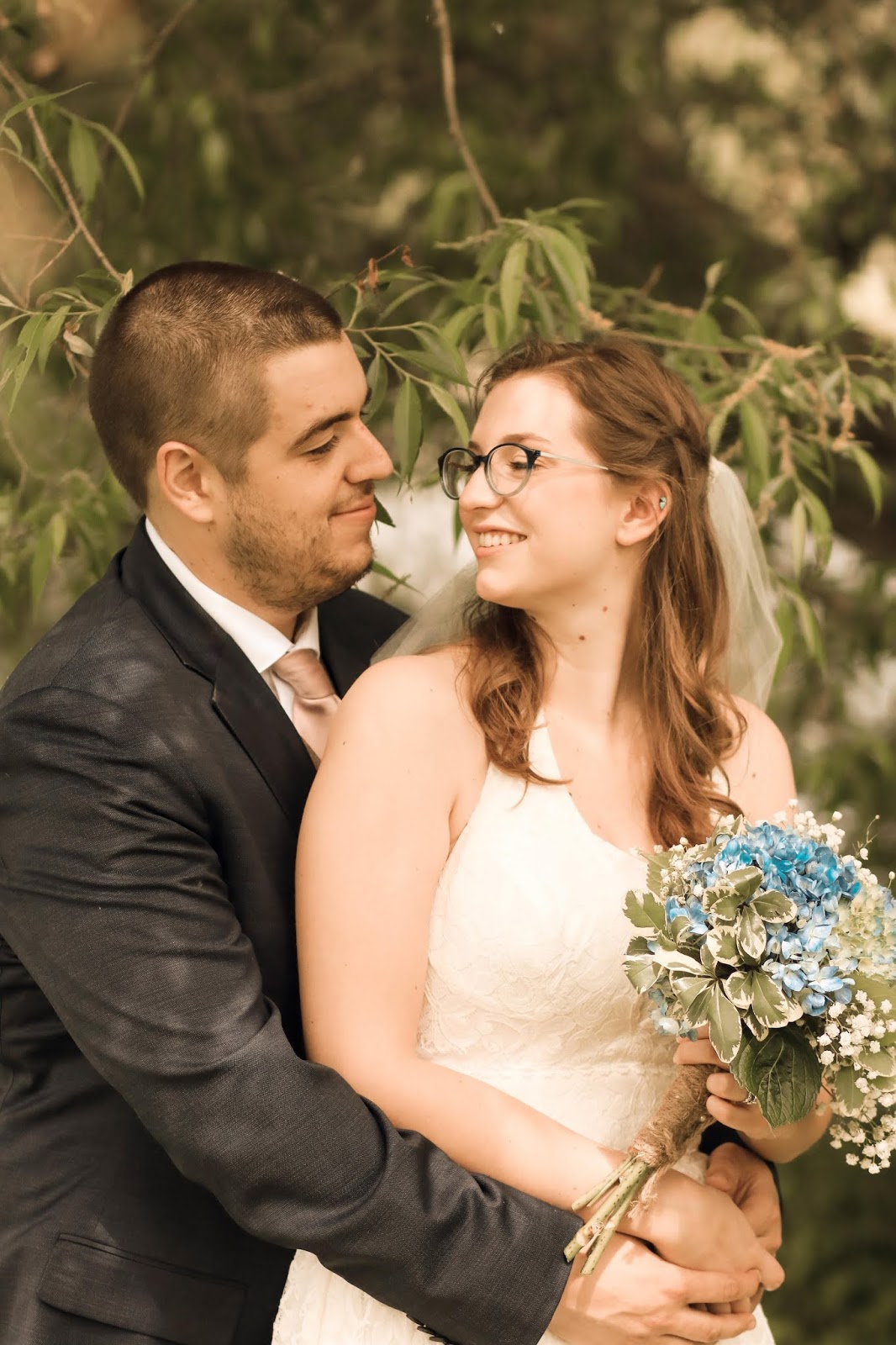
Becca and Stephan's wedding day, June 2nd, 2018. Photo Credit: Unknown
    Despite all the craziness that accompanies field survey, I would not change a thing. I love every second of it. I have been able to see so much of our beautiful country that I’m afraid I would have never seen otherwise! Mountains, valleys, forests, plains, you name it, I’ve worked there. I have completely geeked out over more artifacts than I can count, every time I find a projectile point, its like the first time! This job is so rewarding in so many ways and I am forever thankful to be able to have a career doing what I love. Looking back, I didn’t realize that my time at FSJ, learning in the field and in the classroom from Dr. Nassaney and my peers, would be so influential, and ultimately shape my life into what it is today.
Becca working in the field alongside beautiful scenery. Photo Credit: Unknown
    Unfortunately, this year looks a little different than usual as we are still dealing with the effects of COVID-19. Typically, we would be in the field already, however, while some CRM companies are getting back to work, others are not, and the number of available projects is limited. For now, Stephan and I are content on waiting for the field season to really begin. Although we are eager to be digging again, working in our garden will have to do for now!
Wishing you all a safe and healthy summer,
Rebecca Miller

Wednesday, June 10, 2020

FSJAP Alum: Lucy Clark

Hi Fort Followers, 
This is Lucy and I’m back with another blog all about my job as an independent study student for the Project, COVID-19, graduation, and how self-isolation became the new norm. As most of you know, I work for the Project in the archaeology lab at Western Michigan University. I digitize field notes, take inventory of artifacts, attend events to help educate the public on the Project, as well as other tasks. Well, COVID-19 has impacted all of this. Since I couldn’t really do my normal tasks during the statewide shutdown, I had to adapt and do whatever work I could complete from home. My job since the middle of March till the end of the semester was to digitize field notes from home. While I would have liked to have been in the lab doing all kinds of interesting archaeology related work, I am glad I was able to still do some work for the Project during this crazy time.

Lucy Clark, back at home wearing her face mask. Photo by Lucy Clark.
In late May, I got the unfortunate news that field school would be cancelled for the summer. I was not surprised given the state of everything with COVID-19, but I was still bummed because I was hoping to be a part of the Project again this summer. While there may not be a field school this year, there is still a lot Fort St. Joseph related activities you can partake in! We have blogs being posted every week, as well as two books written by Dr. Nassaney that you could read, and it couldn’t be a better time. We can still learn and celebrate Fort St. Joseph while getting excited for next year’s field season!
As for me, I am graduating this summer with a degree in anthropology! My plans have changed because of the pandemic, but I am still determined as ever to get a job in archaeology as soon as I can! I hope to get into cultural resource management as soon as more archaeological sites start to open back up. I would love to work on projects all over the country, eventually working my way southwest. I also hope to be a part of the Project in some capacity next year, as I love Fort St. Joseph and want to stay as connected to it as much as I possibly can!

Wednesday, June 3, 2020

FSJAP Alum: Meghan Williams

Hello all! My name is Meghan Williams and I was a part of the Fort St. Joseph Archaeological Project from the Summer of 2017 till the Spring of 2019. I played a few roles in the Project (field student, public outreach coordinator, and museum intern), and I deeply enjoyed my overall experience with the Project. In July 2017, I was a student during the 42nd Fort St. Joseph Archaeological Field School. That is when I fell in love with archaeology and knew I would want to pursue it as a career. I graduated from Western Michigan University in December of 2017, and that following summer I was one of the public outreach coordinators for the 2018 field season. Afterwards I decided to stay with the Project a bit longer as the museum intern until the spring of 2019. My time with the Project has exposed me to so many different experiences, and has taught me so much about archaeological techniques, public engagement, disseminating information, and curation work.

Meghan Williams excavating during the at Fort St. Joseph in 2017. Photo by Emily Fletcher.

           During my time with the Project I had the opportunity to meet incredible archaeologists and many others who shared a passion for history. I have made lifelong friends, and those I know I can rely on to help me with my research and future career, because they are always available to answer my questions or proofread my work. One of those individuals is Emily Fletcher, who was my pit partner in the 2017 Archaeological Field School. She has always encouraged me to pursue my dreams, and even recommended her study abroad university when I was applying for my master’s programs. One of my fondest memories of field school was with her. We were incredible pit partners because we knew each other’s strengths and weaknesses and used that to our advantage. For example, she was much better at drawing the level maps than me, so when we had to map a level I would measure and plot, and she would draw. We were a very efficient team, in that sense. I enjoyed excavating and swapping stories with her. She told me about the University of Aberdeen and her adventures in Scotland. It was both inspiring and encouraging to hear about archaeology in other parts of the world and how it is done. We are now both pursuing a master’s degrees under the large dome of archaeology. She is currently at Purdue University studying Digital Archaeology, whereas I am at the University of Aberdeen studying Osteoarchaeology. 


Meghan Williams and Emily Fletcher during the 2017 Archaeological Field School. It had been a long hot day! Photo by Meghan Williams.
Before I move onto my current studies, I have one more memory I would like to share. Ele Hein and I were the public outreach coordinators for the 2018 Archaeological Field School. We got on like two peas in a pod, and I am forever thankful for her patience and hard work. FSJAP is a wonderful project and it is not always the glamour of the field, or invigorating discussions at the lecture series, but sometimes it is the mundane more behind-the-scenes work. We spent many hours working side by side at the Stables, library or museum and I am very fond of those memories. We spent many hours working on banners, flyers, pamphlets, and it was during that time that my work ethic and time management really blossomed. It is interesting to look back now and be proud of those stressful times; however, we beat those hurdles and I have a killer work ethic now. 
I am currently completing my MSc in Osteoarchaeology at the University of Aberdeen. Right now, I am working on my master’s dissertation and I am set to graduate in November. I love living in Scotland and learning about their history through archaeology. Archaeology has this wonderful aspect in its ability to tell unknown stories. I have learned so much here and I am excited to continue learning about the world through archaeology. The Fort St. Joseph Archaeological Project has given me many opportunities and I am thankful for all of the skills I have learned. My time as public outreach coordinator and museum intern greatly assisted in my ability to communicate and disseminate archaeology to the public. To me archaeology is ultimately for the public, and one needs to have the skills in communicating our knowledge in a way that the public can understand. Fort St Joseph has taught me how to hone these skills, as well as fuelling my interest in public archaeology. 
I hope everyone is staying safe during these uncertain times. 
Best, 
Meghan 

Thursday, April 2, 2020

From Fort St. Joseph to Fort Ticonderoga: An Alumni Update

Hello Fort Followers,
John Cardinal here, and I hope everyone is staying healthy and safe! I participated in the 2013 field school, was a Fort St. Joseph co-intern with Aaron Howard from 2014 to 2016, and worked as site photographer during the 2015 field season. A lot has happened since graduating from Western Michigan University and moving on from the Project. It's hard to believe it has been five years since I was last a part of Fort St. Joseph! 
After the 2015 field season, I volunteered for a month as an archaeological crew member at Fort Michilimackinac, then continued as the Fort St. Joseph intern until spring 2016. After I obtained my degree in history and anthropology, I worked seasonally for Mackinac State Historic Parks (Fort Michilimackinac) as a paid archaeological crew member under the direction of Dr. Lynn Evans. During the off seasons, I worked a variety of jobs in order to diversify my skill set, including volunteer work for the collections department at the Kalamazoo Valley Museum.
John working at Fort Michilimackinac as a professional archaeologist. Photo Credit: Anonymous.
The things I learned from the Fort St. Joseph Archaeological Project, Fort Michilimackinac, the Kalamazoo Valley Museum, and various other jobs and hobbies have given me a unique set of skills. In the early summer of 2018, a good friend of mine and fellow Fort St. Joseph alumni Catherine Davis, shared a job posting for, you guessed it, yet another fort! Fort Ticonderoga in Upstate New York, on the shores of Lake Champlain, was looking to hire a Preparator. This newly founded position would include the construction of exhibits, making individual storage and display mounts for collection objects, assisting with on-site archaeology, among other tasks. My previous work history of archaeology, collections handling, general tinkering, and college apartment maintenance presented me a unique opportunity. 
John assembling a museum display at Fort Ticonderoga. Photo Credit: Fort Ticonderoga Staff
I accepted this position in late summer of 2018, and I have been a part of the Fort Ticonderoga team ever since! Since I have started working here, I have learned a lot about the current methods for displaying collection’s objects, disseminating information, on-site real-world archaeology, and how institutions function as a whole. I firmly believe that in order to understand archaeology’s role in today’s institutions, one must have a well-rounded set of experiences. 
Best,
John Cardinal

Wednesday, March 11, 2020

Raegan's Alumni Update


A projectile point found in Wisconsin. Photo by Raegan Delmonico.
Hey Fort Followers! 
It's Raegan here, the 2019 lab coordinator back with another FSJ blog! Since my last video blog at the end of the 2019 excavations at Fort St. Joseph, Ive been able to get my foot in the door and work on my first few commercial archaeology jobs! At the end of the 2019 field season, I headed west to Wisconsin! I worked with the University of Wisconsin-Milwaukee Cultural Resource Management on a phase III project in Sheboygan. It was definitely a learning experience for me. I was able to gain experience working with lithic projectile points and stone tools, this was a big change compared to the french colonial artifacts I had previously worked with. The excavations were also a lot bigger, as we worked on large blocks divided into 2x2m units brought down in 10cm levels. It was a really awesome experience, and a really cool project to be a part of!
A weekend hike into Bryce Canyon. Photo Credit: Anonymous
Once the project in Wisconsin came to an end, I geared up to work on another project even further west in Utah! The project in Utah was a Phase I survey, which means a lot of hiking! The project started in northern Utah in the Uinta Wasatch Mountains, it was difficult terrain but the views were so pretty. The archaeology was also pretty cool, we recorded both historic and prehistoric sites. We surveyed land in southern Utah too. Getting paid to hike and record archaeology all day, while surrounded by beautiful red rocks, was totally wild. I've learned so much from all of the projects I've worked on so far and I can't wait to gain more experience in archaeology!

Obsidian blade excavated in Souther Utah. Photo Credit: Raegan Delmonico.

Thursday, February 13, 2020

My Adventures at the SHA

Hi everyone,
This is Cameron getting back to you all on some of my recent happenings with the Fort St. Joseph Archaeological Project. A month ago, a few of us from the Project (past and present) took a trip to Boston to attend the Society for Historical Archaeology’s conference (the SHA). This conference is what Dr. Nassaney calls “The granddaddy of all the historical archaeology conferences,” and it would be my first archaeological conference. Better yet, I would be presenting a poster about public archaeology during the 2019 field season at Fort St. Joseph. So, you could say that I had waited in anticipation for this trip for months. 

During the beginning of last field season Dr. Nassaney had suggested that I should organize some students to make a poster for the SHA. I proposed that it could be about public archaeology, given that I have learned a lot from and enjoyed that facet of the Project. After I had put my initial idea out there, I organized a group of us to work on the poster, which included Raegan, Erika, Alex, Dr. Nassaney, and Hannah. So, throughout the rest of last year we worked on the poster, prepping it for the conference. 
The poster we produced for the conference. Design courtesy of Cori Ivans. 

Getting to the conference was an adventure in itself. Alex and I carpooled to Erie Pennsylvania in a rental car to stay the night at Evan’s apartment. Evan had spent the last semester at Mercyhurst as a graduate student under the tutelage of Dr. Malischke, so he hooked us up with a ride from Erie to Boston in a large van with four other people. We really hit it gold on our ride there, as we had a spacious van to relax in as we traveled through the rest of Pennsylvania, the entire length of New York, and into Massachusetts. 
Once we arrived at our hotel in Boston, we crammed six of us into a double, which included Evan, Alex, Raegan, and two other students from Mercyhurst. Let’s just say that we were all living in close quarters for the next five days. But this wasn’t too bad. All of the best memories are made with a slight tinge of adversity. And besides, most of our time was spent meandering about the hotel and the city. 
All of this transpired between Monday morning and Tuesday night. But, once I had my early rise on Wednesday, the conference had finally begun, and I was ready to have at it. I spent my first day going from to presentation to presentation, listening to a variety of archaeologists discuss their research. This is what the majority of the conference consisted of, along with networking with other archaeologists. Which combined with all the late-night revelry, could easily lead me to burn out too quickly. I had to remind myself that I should treat my time like a marathon not a sprint, I had the entire week to meet new people. 
            By the time Thursday night came around somehow a group of us managed to sneak our way into a party thrown by the University of Massachusetts Anthropology department. You could say we were unofficially invited, but we didn’t know anybody there. So yeah, technically we crashed their party. This kind of carousing around while attending presentations and networking, continued on throughout the entire conference, and when Friday rolled up, I had burned out. I just didn’t have the will to pace myself knowing that I could be missing out on the next potential adventure. So, with my presentation coming up on Saturday, I knew that I would have to get up early since it was scheduled in the morning. A commonsense approach to time management would obviously imply that I should go to bed early, but this wasn’t the case. 
With a bit of caffeine, I woke up feeling invincible and ready to take on my first presentation. Fortunately for me, despite my depletion the presentation went well. People were interested in the poster, and honestly it was much more of a relaxed setting than I had anticipated. People would stop by to check out our poster and ask questions. It was a good opportunity to show people what I have done for the past two years at FSJ, and how the Project conducts public archaeology with the Niles community. Afterwards Alex and I celebrated by having some oysters for lunch. But once again my exultant mood from my recent success started to wane, and the effects of the conference began to hit me. I tend to get despondent when I am feeling depleted, so despite my fear of missing out I had to get some rest if I wanted to enjoy the rest of my stay. 
Raegan and I the morning of our presentation. Photo by Erika Hartley. 
            With my final hours of the conference at hand, I had managed to utilize the most of my time to meet more professionals. This was one of my most important goals I had in my mind. Initially when I first arrived, I thought it would be best to playthings safe and act formal. But, after a few days immersed in the conference atmosphere, I realized that I had to lighten up a little or else people would think I was a rookie. Not that I wasn’t honest about my status as a burgeoning archaeologist and a first-time attendee, I just didn’t want to seem too green. This worked in my favor as I accomplished my goal, as I had met potential employers and professionals whose work interests me. And with the conference coming to a close I spent my final hours enjoying my time with friends over some Italian cuisine, and drinks at the hotel bar. 
Fort St. Joseph members past and present reunite during the SHA. Photo by Amber Neeley.
            Overall attending the SHA was a rewarding experience that I plan on repeating in the future. I made some good memories and good connections. Leaving the conference was a hassle given that six other people were packing at the last-minute on about three or four hours of sleep. We still managed to get by without harming one another. It was an eight-and-a-half-hour ride from Boston back to Erie, and another five for Alex and I to drive back to Michigan. It was a quiet ride back, but we all survived the SHA. And reflecting back on it all, I realized that my adventures with these people aren’t over, as we are all working towards our future as archaeologists. 
Until next time,
Cam