Friday, August 2, 2019

Archaeology is Like A Box of Chocolates...

          Hello again, everyone! This week I had the opportunity to speak on Media Day (August 1) in front of Niles community members and visitors from Western Michigan University. I shared about my experience with the Fort St. Joseph Archaeological Project this summer.
          There was a quote Dr. Nassaney told us on the first day of orientation back in June, "Archaeology is like a box of chocolates, you never know what you're gonna get." I chose to speak about this not just because I have a sweet tooth almost as big as Gary's (we have a friendly dessert-eating competition at the stables) but because I think it also applies to field school. I expected to learn excavation techniques and fur trade history, as well as various archaeological skills to put on my resume. Yet, I've gained so much more.
          My peers and I are now able to look at the soil zones of a unit and distinguish where plow zone ends and occupation zone begins. This is the undisturbed soil where those in the fort were living during the 18th-century. We have also learned the weight you feel when dropping a lead show into your hand means it's not just a pebble. I think this heavy drop in your palm is one of the best feelings while wet screening.
          There are other things I never imagined to find in this little box of chocolates. One of those is that I would live with 15 other strangers and love every minute of it. We come from all over- the east and west sides of the state, New Jersey, Ohio, and even Oklahoma. Yet, somehow through lots of inside jokes, shared experiences in the trenches, van rides together, and overall support for one another, we have created our own little home here in Niles.
          I think it helps that community members have welcomed us with open arms since day one. Sure, they have cooked us some delicious and greatly appreciated meals for our crzy bunch of people. They have also shared stories and Niles history with us, in addition to lots of devoted time working on the site. I've realized that we would not be able to do our research on the 18th-century fort community if it weren't for the integral support of the present-day community.
          Another sweet surprise the field school has offered is exposure to different career avenues. As I'm sure you already know, curation has been this year's theme. We've had the opportunity to speak to museum professionals, visit museums, and learn behind-the-scenes practices for taking care of artifacts. I've actually gained an interest in the idea of preserving these objects once they're removed from the ground and crafting exhibits to educate the public. Perhaps if I use the archaeological skills I've gained to pursue a career in curation, I can inspire future generations to join a field school and discover their own box of chocolates!

Sincerely,
Heidi

Thursday, August 1, 2019

Curating for the Future: Dr. Terry Martin's Lecture


Hello, Fort Friends! This is Moline again. Tonight we had an amazing guest lecture by our very own Dr. Terry Martin, Curator Emeritus of Anthropology at Illinois State Museum in Springfield, Illinois.  Dr. Martin is a zooarchaeologist, meaning that he studies animal remains in order to better understand past cultures.  Dr. Martin gave us some really interesting insight into the world of curation and museum work, and I’m going to share some of the main talking points with you all!


One of the biggest themes Dr. Martin touched on was the concept of “institutional memory.”  Basically what this means is that an institution has a certain way of doing things, and a certain history goes along with that protocol.  This can include any number of different things, like the collection of artifacts housed at an institution, the way that the artifacts are handled, any difficulties or challenges experienced by the institution, etc.  Having a good sense of an institution’s memory is absolutely crucial for being a good curator.  If you don’t know the history of the artifacts in your collection, or the general protocol used for them, you’re not going to be able to do the best job possible with curating them.  

As I’m sure you already know, being a curator is a big job!  Dr. Martin broke it down for us by giving us four “core activities” of a curator.  They include management of collections, organization of and assistance with exhibit design, education, and interdisciplinary research.

You might be surprised at how interdisciplinary archaeology actually is:  archaeologists often work with experts from all different fields, including geology, paleontology, zoology, history, the list goes on!  Having this kind of interdisciplinary approach is critical for doing good archaeology.  Without the help of experts from different fields and disciplines, it would be impossible to glean the same amount of information from the artifacts, ecofacts, and features that we recover at our sites.


Perhaps one of the most exciting aspects of archaeological work is the potential that exists for future generations to enhance our field.  As Dr. Martin pointed out, there are new techniques (for example, DNA, stable isotope analysis, and AMS radiocarbon dating) being developed and, perhaps most importantly, new questions being asked that are helping us to become more and more knowledgeable as we progress in the world of archaeology.  Many of these questions and techniques were not even envisioned until fairly recently!  With these new developments, we can use old collections to answer new questions.

Thank you all so much for keeping up with the Fort’s activities! 

Happy digging!
Moline


Wednesday, July 31, 2019

History of the Fort St. Joseph Jesuit Mission

Hello ladies and gentlemen… my name is Alexander, and today I will be writing about the Jesuits, including their founder, who they were, and their involvement in New France. My interests in this subject, besides being a lover of history, is that I am a lover of ancient Christian traditions (both east and west), its symbolism and mysticism, as well as learning from the good and the bad. Before we speak about the Mission at Fort St. Joseph (the earthly father of Jesus as well as the patron saint of New France), we must first start with the founder of the Jesuit order, that being saint Ignatius of Loyola (Catholic saint). Ignatius was born October 23, 1491, in Azpeitia, Spain, and died July 31, 1556, in Rome Italy, where he is now entombed. He originated as a military leader, on his way to glory and fame, when it all came to a sudden halt when a cannonball shattered his leg, thus forcing him to a hospital, where he would eventually recover. This time in rehab was spent not only to recover physically, but spiritually as well, as he spent many of his days not only reading the Bible, but the Lives of the Saints as well (this is a book that shows that the everyday person, if they try, can be god-like too). This, over time, caused him to turn his life around and start anew. After going through much personal growth and trials, Ignatius (at the age of 43), with the blessing of Pope Paul the III, formed the Society of Jesus, with its focus being on the Trinity, Christ, and the Holy Eucharist. Besides running the order, Ignatius also spent his time building homes for orphans, catechumens, as well as penitents. He was a true mystic, and is best well remembered for his book, the Spiritual Exercises.
Saint Ignatius of Loyola.
From Brittanica Online
With the Jesuits being one of the best educated missionaries next to the Dominicans (another Catholic Order) their education would serve them well as they were to be sent to the lands of New France, and thus become the principle religious order in charge of converting Native Americans. Successful missions required funds, with many of these coming from private donations, landholdings (such as missions in Canada), and government allotments. In the case of the mission at Fort St. Joseph, it was the needs of the mission that came first, then the fort (this would vary from place to place). Many of the missionaries found the lack of converts frustrating, and the potential danger intimidating, as this was an unknown world to them. They encountered issues with native languages, in their attempts to put down superstitious beliefs, and of course, cultural barriers. Many native groups converted only in times of extreme hardship, such as baptizing a dying child, or when faced with military, demographic, or economic turmoil. One group, the Algonquians (who were the French’s allies), were found receptive to the Catholic Christian faith, as they saw the Jesuits to be representatives of the French crown, whom the Algonquians needed to help fight the Iroquois and the British, thus forming the link between religion and trade.
Baptismal records during the 17th century.
From the Fort St. Joseph Archaeological Project
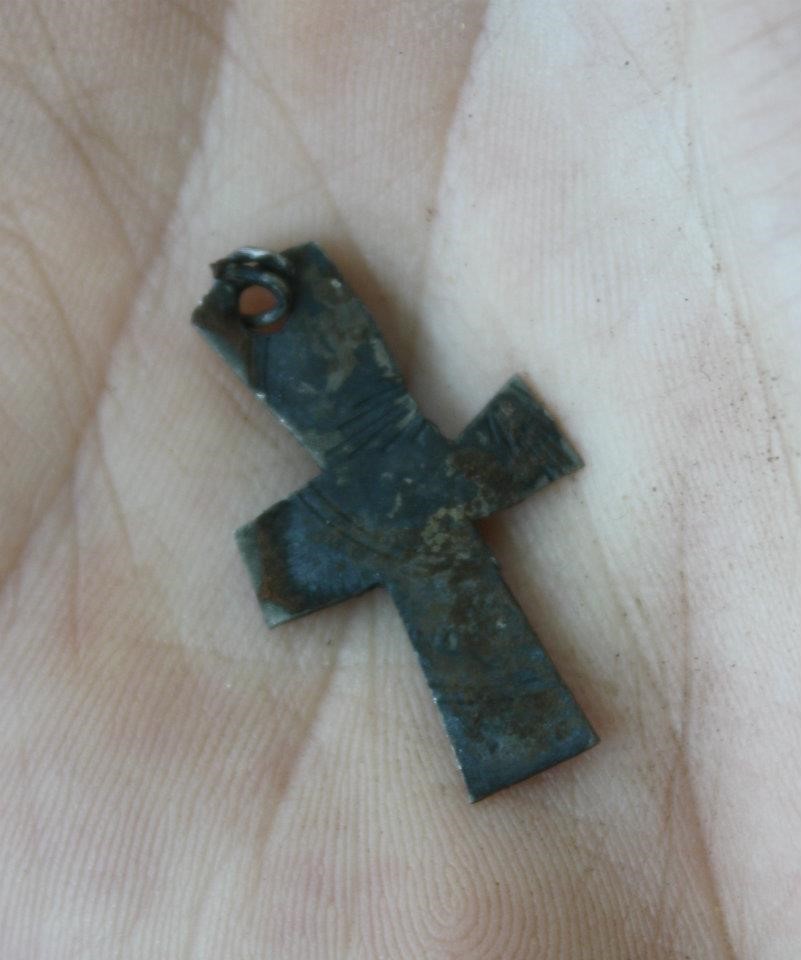
In terms of knowing certain information about some of the Jesuit activities around the Fort St. Joseph area, we cannot only look at artifacts (with many religious memorabilia being found, especially crosses) but also the missionaries’ records as well. From these often incomplete documents, we can decipher a couple important things, those being: missionaries did not stay long at the fort/were not continuously present and there was a persistent call for priests (to baptize the inhabitants of the fort), which gives us an idea of the amount of marriages, births, and deaths that happened within the community, with a total of 5 marriages, 141 baptisms, as well as 17 if not more deaths being recorded within a 40 year time span.
The Jesuit missionaries left an integral mark on Fort St. Joseph, as well as on the native inhabitants, thus preparing the way for French and native relations, and that of the Fur Trade itself.


Sources Utilized:
Nassaney, Michael S. and Jose Antonio Brandao
2019. Measuring Success in the Jesuit Cause. Paper presented at the annual Conference on                  Historical and Underwater Archaeology, St. Charles, MO, January.

https://www.franciscanmedia.org/saint-ignatius-of-loyola/

Tuesday, July 30, 2019

Archaeology, No Bones About It! Well, actually…


Tuesday is upon us, ye followers of the Fort! Alex reporting back to you this week on a unique and interesting opportunity, wherein field school students got to acquaint themselves with faunal (animal bone) remains. Likewise, I am also pleased to announce that longtime colleague of the Fort St. Joseph Archaeological Project and Curator Emeritus of the Illinois State Museum Dr. Terry Martin is officially back in Niles, and will be sure to make an appearance at our annual Open House this weekend! Following a shortened day in the field due to inclement weather, students filed back into the house for some afternoon lab work, headed personally by Dr. Terry Martin.
Dr. Terry Martin giving a faunal workshop.
Photo by Hannah Rucinski

Terry is as well-versed as anyone in the zooarchaeology business (the study of animal remains as it relates to archaeological finds), and the students were more than happy to glean whatever expertise that they could from his instruction in identifying specimens belonging to the FSJ Collection. To begin the workshop, Terry introduced us to the most common animal types found within the context of Fort St. Joseph, such as whitetail deer, bear, pigs, beaver, and turkey, to name a few. It is highly imperative for we as archaeologists to understand the presence of various animal groups at the Fort, so that we can begin to construct the nature of the relationships the Fort inhabitants had with their surrounding resources. Oftentimes, harvesting food from these animals was just skimming the surface of the various uses that were available.
Photo of Heidi using Dr. Terry Martin's comparative collection
to identify a bone from Fort St. Joseph.
Photo by Hannah Rucinski

The majority of our time was spent working through faunal remains from the FSJ Collection that had yet to be correctly identified. One of the manners in which we successfully completed these tasks was by utilizing Terry’s comparative collection, which is a collection of animal bones that essentially acts as the benchmark of specimens found at Fort St. Joseph, for instance, the aforementioned whitetail deer, bear, pig, and turkey. Under Terry’s guidance, students worked through some bags and created identification catalogues from a majority of the bone fragments in accessions (groups of artifacts from certain units or unit levels) from the 2013 field season (lab work is always in need of being done, folks). For instance, one catalogue for a whitetail deer tibia would include:

Refit of three bone fragments to form the distal
end of a Whitetail Deer tibia.
Photo by Hannah Rucinski

While conducting faunal analysis, it is also important to list the Latin taxonomical name (i.e. Odocoileus virginianus for Whitetail Deer) for the bone fragments, so that the consistency of identification will endure in the long-term, instead of using generic terms such as “deer,” or “wildcat,” (the latter being the term the French called raccoons in the Eighteenth-century, according to Terry) in order to avoid confusion. In addition, it is also relevant to list exactly what the provenience of the bone is in the overall anatomy of the species being dealt with. For instance, on the catalog above, you will see that this three-piece tibia fragment is from the right side of the deer, and it is from the distal (bottom portion) of the tibial shaft. Now, deer do in fact have four legs, and regrettably, it is tough to discern which leg it is from given the small bone fragment.

Keeping with the 2019 theme (Curation: Preserving the Past for the Future), the processes of faunal analysis are also an indispensable piece of our curation methods at Fort St. Joseph. One might wonder, "why on earth do we save literal mounds of bone splinters, fragments, and completely intact specimens?" The fact remains that every bone has a story of the past, moreover, a story from the history of Fort St. Joseph, to tell. To comprehend why cut marks exist on whitetail deer femurs, or why tropical parakeet remains are found in southwest Michigan at the site of the Fort, is to demonstrate that we can learn as much about the past of the Fort’s inhabitants as we can in conjunction with the various animals themselves.

To learn more about zooarchaeology and the faunal remains present at Fort St. Joseph, please join us this tomorrow night on Wednesday, at 7pm for a lecture by Terry Martin, the culminating piece of our annual Summer Lecture Series! He will be able to answer any questions that you have about the faunal remains in the collection. We look forward as well to seeing you at our annual Open House this weekend, Saturday and Sunday, 10:00AM-4:00PM both days.
Have a most excellent week, friends!

Au revoir!
Alex Michnick

Monday, July 29, 2019

The 2019 Fort St. Joseph Archaeology Open House!


Since 2002, students in Western Michigan University’s annual archaeological field school, now in its 44th year, have been hard at work investigating material traces of Fort St. Joseph. This year’s theme is “Curation: Preserving the Past for the Future.” We are emphasizing how we conserve the artifacts we collected, archive the associated documentation, and make them all accessible to future generations of researchers and the public. Now in excess of some 300,000 objects and records, we have lots of information to curate for years to come.

The Fort St. Joseph Archaeological Project is a long-term, multidisciplinary, community-based research program that aims to investigate and interpret the history and archaeology of the fur trade and colonialism in the St. Joseph River valley. Public participation in the Project has been central since 1998 when community members asked WMU to help them find their long lost Fort. The public remains involved through our summer camp program, lecture series, community meals, historical walking tours, social media, and, of course, the open house where visitors can witness life in the 18th century and learn how archaeologists work to reconstruct the past.

This year we have gone where no archaeologists have ever gone before—beneath a 20th-century landfill adjacent to an area where we previously identified at least six French colonial buildings. The hope is to determine if the fort continues to the south. Initial investigations have identified some 18th-century artifacts under the dump and we expect that undisturbed evidence may be even more deeply buried.

Take this opportunity to think about the materials in your life that you want to pass along to future generations. How will you ensure that they are properly cared for?  Can you even access photos on old CDs and other obsolete media? Curation is indeed a challenge and one that all of us must be concerned about if we hope to preserve the past for the future.

At this year's Open House, please introduce yourself to a staff member and join in the conversation about curation, Fort St. Joseph, and archaeology in the past, the present, and the future. In the end, our Project is designed to bring people together. Please use our survey to tell us what you like and how we can improve the program. We hope you enjoy the history and archaeology of Fort St. Joseph and seize the opportunity to learn about our latest finds and what we have found out.

Cordially,

Michael S. Nassaney
Principal Investigator, Fort St. Joseph Archaeological Project
Professor of Anthropology, Western Michigan University


Saturday, July 27, 2019

Coming Back to Fort St. Joseph

          Hi everybody, this is Cameron. I’m coming back to you again, and this time as a staff member this field season. I am grateful to be back working in Niles amongst a very welcoming and neighborly community, especially as an archaeologist excavating at a site that has a lot of meaning for so many of you.
          Just to get you guys caught up with my life since my last blog, I have just recently graduated this past spring with my undergraduate degree in anthropology from Western Michigan University, and fortunately I have been able to maintain employment as an archaeologist for the past three months. Over the past year I worked in the lab at Western Michigan University as an independent study student under the guidance of Doctor Nassaney. My job was to create a digital inventory for an artifact collection from a field school back in 1998, and to deaccession any redundant artifacts from that collection which had no research value. Anyways, after I graduated I was offered a job doing this same task. It was a temporary position that lasted for two months. And during that time back in May, I was invited to come to the site in Niles while the trenches were being dug into the old dump site. A few other students and I dry screened for artifacts that were taken from core samples from the bottom of the trenches. And as many of you already know, these samples were positive, and they yielded eighteenth century materials such as wampum, lead shot, and calcined bone.
          Fast forward to the end of June and I was offered employment working as a field assistant as Fort St. Joseph, which I did not hesitate to accept. And since that time I have been living and working right here in Niles. My role as a field assistant is to work along side the students assisting them with excavating their unit, mapping, filling out paperwork, and supervising during lab time while they wash artifacts. And I also work with Gary by prepping the site for pit tours and the upcoming open house next Saturday. The site was littered with debris from the dump, and sprawling with brush. But between the collective efforts of the staff, students, and volunteers, the site is safe and navigable for the public to visit during the open house. 
          I should also mention that since I have began working as a field assistant this season, I have also accepted another job here in Niles working at the History Center. I will be there every Saturday working at the front desk, greeting visitors, educating myself about the history of Niles and Southwest Michigan, and digitizing field notes from the past field seasons at Fort St. Joseph. This is another wonderful opportunity that I am more than grateful to have been offered. And if you happen to be in the area, come visit me so we can catch up or become acquainted.
          Working at both the Fort St. Joseph Archaeological Project, and in the Niles History Center, are both learning experiences that will help me traverse my through my journey of life, and which I have no doubt will help me grow as a person. I can not succeed on my own, and I owe it to the people who have guided me along the way. I am indebted to the community of Niles and the faculty from Western Michigan University for everything they have done for me in my past, my present, and my future.

Hasta Luego,
Cameron


Friday, July 26, 2019

Fort St. Joseph Revealed: The Blog

Lucy intently wet-screening. Photo by
Hannah Rucinski
Hello all! My name is Lucy and I wrote the blog on our dewatering system at the Fort St. Joseph archaeological project! Today, I am back with another blog on a lecture we had at the Berrien Springs courthouse. This lecture came from our very own principal investigator at Fort St. Joseph, Dr. Michael Nassaney. His lecture, Fort St. Joseph Revealed, was a comprehensive overview of the last 20 years of archaeology at Fort St. Joseph.

Dr. Michael Nassaney giving his lecture at
the Berrien Springs Courthouse Museum. Photo
by Alex Michnik.
          Obviously, an hour lecture can not cover all of the detailed and important work that has been done at Fort St. Joseph, but it was a great overview of the last 20 years. Dr. Nassaney began by discussing the history of the fort's inception and how its location was chosen. Originally, the French were in America on a search for a route to China, which they did not find in Michigan. Instead, they found many fur-bearing animals, such as deer, beaver, and muskrat, which were extremely valuable at the time. Namely, the fur trade was an important means of maintaining alliances with the native peoples of the area. The Fort was located on the St. Joseph river, which provided access to an important transportation route. This water route attracted large groups of native peoples, who then occupied the surrounding area. Thus, the location of the Fort made a lot of sense to the French.
          After discussing the fort's location and a bit of its history, Dr. Nassaney began discussing the archaeology at Fort St. Joseph and how it did not come easily. Before there could be any archaeological work done, they first had to find the Fort. Many universities tried and failed. With the help of historical documents and Dr. Joseph Peyser's research, WMU archaeologists were able to locate the Fort.  After locating the Fort, and partnering with Niles, Dr. Nassaney and colleagues were finally able to do some archaeology! There is an endless number of things to be said about the archaeology done at Fort St. Joseph, including all of the survey, testing, and dewatering, but one thing that I took away from Dr. Nassaney’s lecture was that our archaeology helps to recreate daily life. Our goal is to recreate that life with as much accuracy as possible, and to tell the narrative as it was and not as we assume it to be. Upon excavating at the site, we have been able to paint a partial picture and begin to understand what some daily activities looked like. From the copper alloy kettles that they used for cooking, to the thousands of glass beads they used for embroidery, we can get a glimpse into what daily life was like at Fort St. Joseph. Dr. Nassaney stressed the importance of fully understanding what we were finding and not to assume that everything was being used for what it was intended for. 
When is a thimble not a thimble? When it's
used as a tinkling cone! Photo from Katelyn Hillmeyer
          A great example and riddle that Dr. Nassaney used was, "when is a thimble not a thimble?" At the Fort, a thimble is not a thimble when it has a hole intentionally punched through the top to become a tinkling cone, which is used for adornment. In any case, it would have been easy to say that this particular thimble was a regular thimble; to recreate actual life, you have to make sure you aren’t presuming what the picture looked like. After the lecture, our field school students and staff got together and discussed how every single one of us had learned something new about the Fort, even staff who have worked here for years! This just goes to show that there is always something new to be learned, and the history of Fort St. Joseph is still being revealed. If you want to see some of the amazing archaeological work we do at Fort St. Joseph, you can see it in person at our Annual Open House on August 3rd and 4th from 10am to 4pm! This season,we are exploring new areas of the Fort where we are making some exciting discoveries!